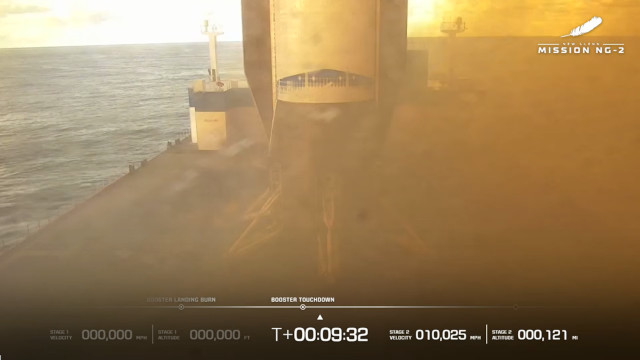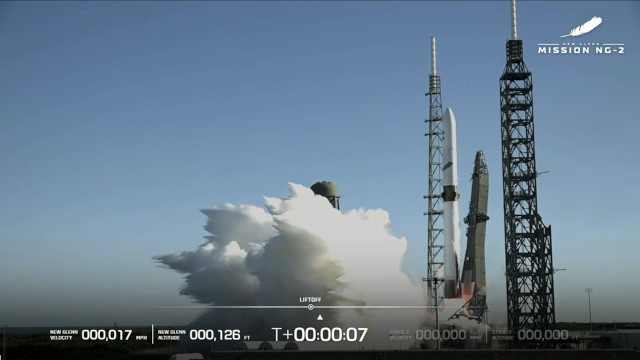
A few hours ago, NASA’s ESCAPADE (Escape and Plasma Acceleration and Dynamics Explorers) twin probes were launched atop a Blue Origin New Glenn rocket, which accomplished its mission, called NG-2. One goal for Blue Origin was to land the first stage, which was a successful one just over 9 minutes after launch. After approximately 33 minutes, the probes, named Blue and Gold, separated from the rocket’s second stage and began a long journey to Mars to study its magnetosphere and the Sun’s impact on the red planet.
The ESCAPADE mission aims to demonstrate the feasibility of exploring the solar system at a lower cost than traditional missions based on big spacecraft. Blue and Gold are relatively small, measuring 60 x 70 x 90 centimeters (24 × 28 × 35 inches) and each weighing 535 kilograms (1,180 lb) at launch.
The ESCAPADE spacecraft’s route isn’t the one typically used for trips to Mars. The first stop on their journey is toward the zone called Lagrange 2, or simply L2, about 1.5 million kilometers from Earth. They will spend about a year there before beginning a series of maneuvers that will set them on a course to Mars, a journey scheduled to last about 11 months. At the end of their journey, in September 2027, they will enter a highly elliptical orbit that will be slowly adjusted until they reach the desired orbital parameters to begin their scientific mission. Testing this new route will help set up other missions to Mars with greater flexibility.
In the (Earth) spring of 2028, the ESCAPADE spacecraft will begin surveying the Martian magnetosphere to understand how it was affected by space weather over time. The solar wind impacts the Martian atmosphere, and various studies conducted in recent years showed how it has slowly dispersed into space an atmosphere that was similar to that of Earth when Mars was young. Gaining further insight into the processes underway will help improve the safety of future missions, including human missions.
About five minutes after the separation of the ESCAPADE spacecraft, a Viasat technology demonstrator, which remained attached to the New Glenn rocket’s second stage, was activated. It’s part of a collaboration with NASA within its Communications Services Project, which aims to develop a new era in space communications. The demonstrator is testing a solution using Viasat’s InRange technology as a radio relay.
This launch was also significant for the successful landing of the New Glenn rocket’s first stage on the Jacklyn automated sea platform. Blue Origin has accumulated experience with many landings of its New Shepard rocket, but the differences between the two rockets still made this feat difficult. The New Shepard is a small rocket that performs “hops” to launch a spacecraft on suborbital journeys and land nearby. New Glenn is a much larger rocket that launches vehicles into orbit and requires many more maneuvers to land.
Nearly 10 years after SpaceX’s first success, Blue Origin has successfully landed a first stage on an orbital mission as well. For Jeff Bezos’ company, this is a major success that paves the way for partial reuse of the rocket. Blue Origin engineers will carefully examine the first stage that landed yesterday to assess its condition. The plan is to refurbish it for reuse, but this will only happen after thorough examination.
Rocket Lab, the company that built the ESCAPADE space probes, is conducting experiments to reuse at least the engines of its Electron rocket and has plans to reuse the first stage of the Neutron rocket, currently under development. This gives the idea of the difficulty of landing a rocket’s first stage and the importance of having another company do it regularly. This is a historic moment!