
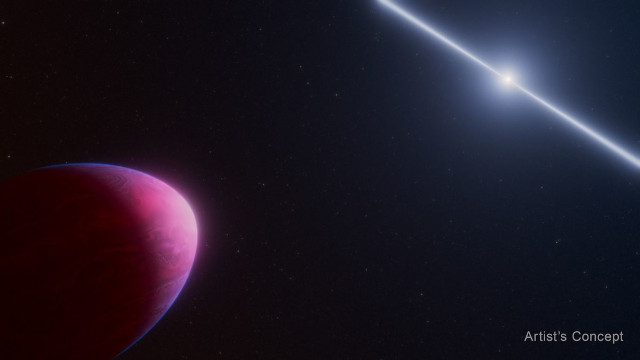
An article published in The Astrophysical Journal Letters reports the results of a study of a gas giant exoplanet cataloged as PSR J2322-2650b, which has a completely abnormal atmosphere composed above all of helium and carbon. A team of researchers used observations conducted with the James Webb Space Telescope to study the atmosphere of this exoplanet, which has a mass similar to Jupiter’s and has a distance from its star that is only one-hundredth of the Earth’s distance from the Sun. The star is a pulsar, adding another unusual element to the system. PSR J2322-2650b can’t be explained by current models of planetary formation.
The discovery of the exoplanet PSR J2322-2650b was announced in an article published in December 2017 in the journal “Monthly Notices of the Royal Astronomical Society” following observations conducted with various instruments. A pulsar is a type of neutron star, the possible remnant of a star after a supernova explosion.
Over the past few decades, some exoplanets have been discovered that survived this type of catastrophe, but PSR J2322-2650b is unique simply because it’s the first gas giant discovered orbiting a pulsar. In this case, it’s a millisecond pulsar, a class so named because its rotation period is between 1 and 10 milliseconds.
The greatest strangeness of the exoplanet PSR J2322-2650b lies in its atmosphere, composed mostly of helium and carbon. The astronomers expected to find typical molecules such as water, methane, and carbon dioxide, but they were in for a big surprise. The observations were obtained specifically with the James Webb Space Telescope’s NIRSpec (Near-Infrared Spectrograph) instrument, which is sensitive to infrared light, while the pulsar generates emissions in other electromagnetic bands. The detections revealed something quite different from expectations: molecular carbon, with molecules made up of two or three atoms.
Normally, carbon binds to other atoms in planetary atmospheres at the very high temperatures found on PSR J2322-2650b. Its distance from its star is only one-hundredth that of Earth from the Sun, with a year lasting less than eight hours. As a result, temperatures can reach about 2,000° Celsius in the hottest areas. Even in the coldest areas on this exoplanet’s night side, temperatures go from at about 650° Celsius.
Another consequence of the exoplanet PSR J2322-2650b’s proximity to a pulsar is that the star generates gravitational forces that significantly deform it. No planet is perfectly spherical, but this one would likely be seen as an egg if it were possible to observe it up close.
Neutron stars can be so-called black widows when they have low-mass companion stars and steal gas from their companions. The consequence is that the pulsar’s rotation becomes increasingly faster, and the powerful winds and radiation hitting the companion contribute to its consumption. Researchers have tried to determine whether PSR J2322-2650b is the remnant of a star in a binary system with a black widow, but this is unlikely because explaining the presence of all that pure carbon remains difficult.
The conditions in PSR J2322-2650b’s atmosphere could also generate truly exotic phenomena, which could explain the detections, even if only in part. Carbon and oxygen in the atmosphere could mix and crystallize when the temperature drops. At that point, pure carbon crystals could float in the upper layers and mix with the helium in the detected molecules. Strange clouds of carbon soot could even contain diamonds.
The problem with this reconstruction is that neither oxygen nor nitrogen was detected. If these elements are present, it would be necessary to explain what process keeps them away from the upper atmosphere. In short, any attempt to explain the observations is fraught with difficult-to-solve mysteries.
For these reasons, the exoplanet PSR J2322–2650b is an intriguing mystery. Its system experienced a catastrophe with the supernova that generated the pulsar. We still know little about what can happen to a planet that survives such an event, and further study of PSR J2322–2650b could reveal what can happen to a gas giant in that situation.
