
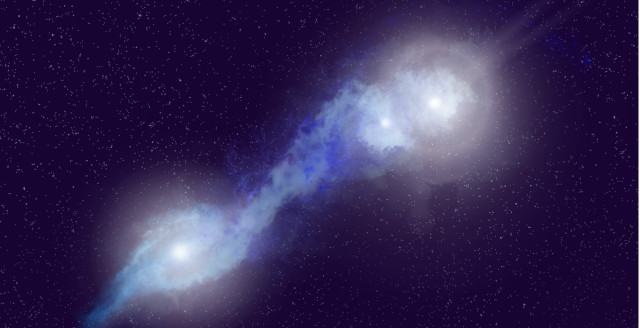
A rare example of three active galactic nuclei in three merging galaxies has been discovered using two radio telescopes: the VLA and the VLBA. The triple system, approximately 1.2 billion light-years from Earth, is cataloged as J1218/1219+1035. This targeted study, conducted by a team of researchers at various radio frequencies, has identified only the third case of a triple active galactic nucleus, the first confirmed through radio observations. This discovery is useful for better understanding certain galaxy merger processes, such as the ones that led to the formation of the Milky Way.
Over the years, astronomers have discovered numerous cases of galaxies in various stages of merging. These cases are useful for understanding galactic evolution processes and refining models describing galaxy growth through mergers. Studies also focus on the role of supermassive black holes, which typically lie at the centers of galaxies, including dwarf galaxies, in these processes.
The system cataloged as J1218/1219+1035 was discovered using NASA’s Wide-field Infrared Survey Explorer (WISE) space telescope. Infrared information suggested the presence of at least two dust-obscured active galactic nuclei in a pair of interacting galaxies. The first follow-up observations were conducted using optical spectroscopy techniques and confirmed the presence of an active galactic nucleus within one of the galaxies, leaving doubts as to the nature of the other objects in the system.
To gain some certainty, a team of researchers examined the J1218/1219+1035 system at radio frequencies using two different antenna arrays: the Very Large Array (VLA) in New Mexico and the Very Long Baseline Array (VLBA), with its antennas spread across a vast area. Three active galactic nuclei were found to be bright in radio observations, the third such case known and the first identified using radio telescopes.
This was an important step in this type of research, but it’s not the last. The plan is to add near-infrared and X-ray observations to obtain further details of the structures of merging galaxies and the energetic emissions from the active galactic nuclei. Observations conducted with radio telescopes such as the VLA and VLBA arrays could be used to identify other systems similar to J1218/1219+1035. Finding more of them would help astronomers better understand how modern galaxies like the Milky Way formed and perhaps even identify supermassive black holes close to merging.
