
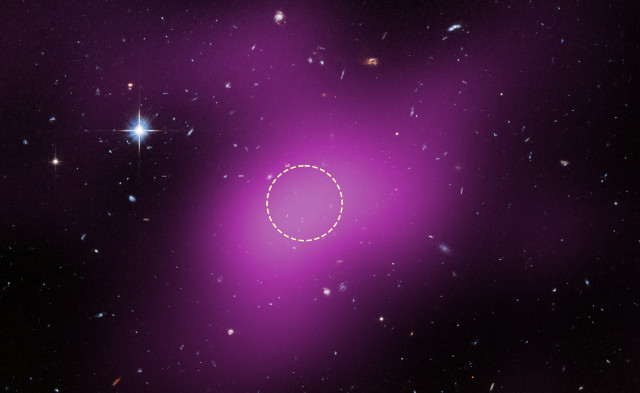
An article published in “The Astrophysical Journal Letters” reports the discovery of what was dubbed Cloud-9, which can be described as a failed galaxy. A team of astronomers used observations with the FAST radio telescope to identify what appears to be a new type of astronomical object, and follow-up observations with the Hubble Space Telescope, the Green Bank Telescope (GBT), and the Very Large Array (VLA) to confirm the existence of the first object of its kind that was identified with reasonable certainty.
Technically defined as a reionization-limited H i cloud (RELHIC), Cloud-9 is a starless gas cloud that is supposed to be composed of dark matter filled with hydrostatic gas in thermal equilibrium with the cosmic ultraviolet background. Cloud-9 will help test cosmological models regarding dark matter.
According to current cosmological models, most of the matter composing the universe is so-called dark matter. The major problem so far is that no one has been able to detect it directly, only through its gravitational effects. For this reason, models have been developed that attempt to explain these effects in ways that don’t require the existence of dark matter.
The Lambda-CDM model predicts the formation of dark matter halos on large scales. It also predicts that not all of these halos host luminous galaxies. Essentially, starless gas clouds should exist when dark matter halos fail to reach a certain critical mass, but until now, no one had succeeded in discovering what could be considered failed galaxies, given that no stars have formed in these clouds of ordinary matter.
An interesting candidate was discovered three years ago during a cosmological survey conducted with the Chinese FAST (Five-hundred-meter Aperture Spherical Telescope) radio telescope and nicknamed Cloud-9. The nickname comes from the fact that it’s the ninth gas cloud identified in the vicinity of M94, a spiral galaxy about 114 million light-years from Earth.
The available observations were far from conclusive because it was possible that Cloud-9 was actually a faint dwarf galaxy and that the stars within it were simply not visible in the FAST observations. For this reason, follow-up observations were conducted with other instruments, which provided detections at different frequencies. The Hubble Space Telescope’s Advanced Camera for Surveys (ACS), the GBT telescope, and the VLA confirmed that Cloud-9 is technically a RELHIC.
The GBT and the VLA measured a cold cloud of neutral hydrogen with a diameter of about 4,900 light-years and a mass about a million times the Sun’s. The VLA also revealed Cloud-9’s spherical structure. Hubble’s detections confirmed that it’s indeed a cloud, ruling out the possibility of it containing stars.
The estimated mass is the hydrogen’s, but Cloud-9 contains dark matter with a total mass that is far greater, estimated at around 5 billion solar masses. These are the predictions of the Lambda-CDM model, and the discovery of a RELHIC provides confirmation. Therefore, its discovery can improve our understanding of galaxy formation processes and the role of dark matter, even in the early universe. However, a single RELHIC example isn’t enough to provide strong support for a theoretical model, so it will be important to find more of these objects.
More observations of Cloud-9 could help us understand its characteristics and confirm its nature. The James Webb Space Telescope would be very useful for obtaining new details about this cloud. Obtaining more information about Cloud-9 and discovering other RELHICs would allow to better test the Lambda-CDM model, other dark matter models, and even other cosmological models that don’t include its existence.
