
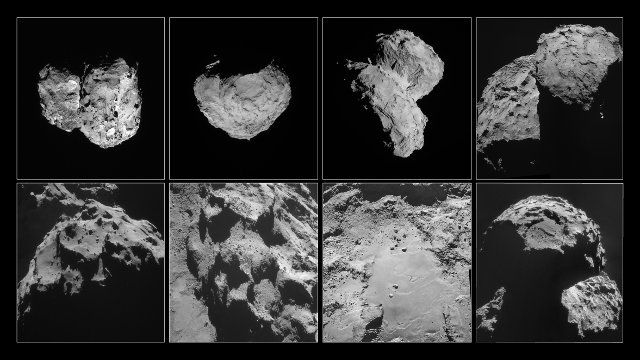
An article published in the journal “Nature” describes a research about the internal structure of the comet 67P/Churyumov-Gerasimenko. A team of scientists, led by Martin Pätzold, from Rheinische Institut für Umweltforschung an der Universität zu Köln, Germany, analyzed data collected by ESA’s Rosetta space probe to provide some answers to the astronomers’ questions. According to their findings, the comet’s internal structure is quite homogeneous and contains no large caves. The total mass was estimated at nearly 10 billion tons.
Comets are mainly made up of dust and ice so their density should be greater than that of water. Instead, the measurements made show that some comets have a density much lower than that of water ice. There are two possible explanations: within these comets there are empty caves or their interior is homogeneous but so porous as to greatly lower the density of the materials it’s made of.
Previously, detections carried out by the Rosetta space probe with its CONSERT (Comet Nucleus Sounding Experiment by Radiowave Transmission) radar showed that the smaller lobe of the comet 67P/Churyumov-Gerasimenko was homogeneous on spatial scales of some tens of meters. To obtain more complete measurements, this research used the RSI (Radio Science Investigation) instrument to study how Rosetta is attracted by the comet’s force of gravity.
Even if it’s limited, the effect of gravity on Rosetta is enough to affect the electromagnetic waves it sends towards the Earth due to the Doppler effect. The spacecraft’s movements caused by the gravitational variations caused a change in the frequency of the transmitted radio waves and their analysis made it possible to create a framework of the gravity throughout the comet.
If inside the comet 67P/Churyumov-Gerasimenko there were vast caves, the local mass decline would have been enough to reduce the attraction of Rosetta so much as to be noticed. In making the calculations, the scientists had to take account of other gravitational influences exerted by the Sun, the planets and even by the larger asteroids.
The next step was to eliminate the influence of the solar wind pressure and the pressure exerted by gases emitted by the comet itself. This was possible also thanks to the ROSINA (Rosetta Orbiter Spectrometer for Ion and Neutral Analysis) instrument, which is used exatly to measure the pressure of the gases emitted by the comet.
The detections conducted by the RSI instrument were facilitated by the shape of the nucleus of the comet 67P/Churyumov-Gerasimenko. The fear was not being able to get good measurements because scientists believed that they had to conduct them at a distance less than 10 km from the nucleus but such an approach would be unwise.
The estimates of the distance to reach to carry out the detections were made thinking of a nucleus that was at least vaguely spherical. Instead, the two-lobe shape of 67P/Churyumov-Gerasimenko makes gravitational variations much more pronounced and therefore easier to measure even at much greater distances.
The precise mapping of the gravitational field of the come 67P/Churyumov-Gerasimenko allowed to estimate its mass at a bit less than 10 billion tons. Also using the models created using the OSIRIS (Optical, Spectroscopic, and Infrared Remote Imaging System) camera, it’s been possible to estimate its volume to 18.7 km^3 and consequently its average density at 533 kg/m^3.
This type of research isn’t finished. The Rosetta space probe’s mission is expected to end in September 2016 with an attempted landing on the surface of the comet 67P/Churyumov-Gerasimenko, which at that point will be too far from the Sun to be active. The approach will allow for even more precise data.
[ad name=”AmazonScience”]
