
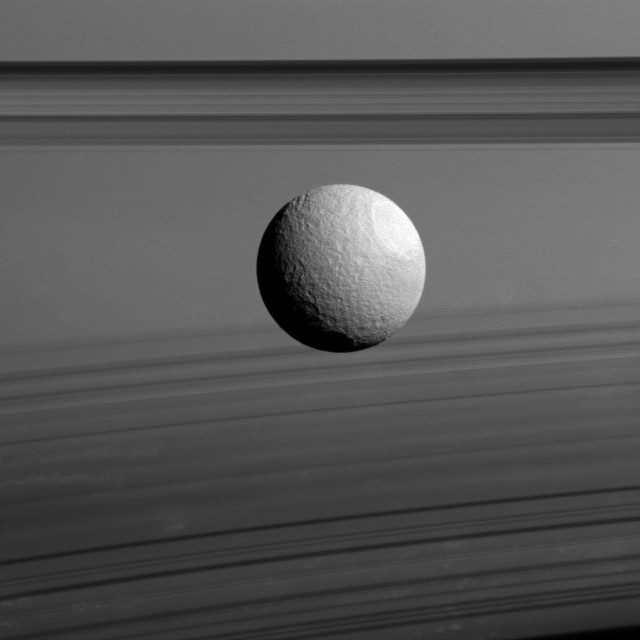
NASA has published a photograph taken by the Cassini space probe that frames Tethys, one of Saturn’s moons, in front of the planet’s rings. They have such a relative position Tethys seems to float between two sets of rings but it’s just an optical effect. The result is a particularly striking image even by the standards of a mission that has been offering stunning portraits of the planet Saturn, its rings and its moons.
Tethys is one of the mid-size Saturn moons with a diameter of around 1,060 kilometers (about 660 miles). It’s essentially a ball of ice, in particular water ice, consequently has a slightly lower density than that of water, the lowest among the mid-large-size moons of the solar system. It contains a small amount of rocks and bits of unidentified dark material on its surface. The rest of the surface is covered with ice and this makes it the second brightest among Saturn’s moons after Enceladus.
The surface of Tethys is covered with impact craters. The largest is called Odysseus, after Ulysses of the Odyssey and the Iliad, and is one of the largest craters in the solar system with a diameter of about 445 kilometers (about 275 miles). It’s possible that at the moment of the impact this moon was relatively warm and malleable because if it had been cold and stiff like it is today probably it would have been torn to pieces by the energy produced by the collision.
The crater Odysseus was discovered by the Voyager 2 space probe in 1981 during its Saturn flyby. It’s precisely this crater that gave Tethys a certain celebrity among the general public because the relative size to those of the moon creates a certain similarity with Star Wars’ Black Death and its planet-destroying superlaser weapon.
This beautiful image was taken in visible light by the Cassini space probe’s ISS (Imaging Science Subsystem) camera on November 23, 2015 from a distance of about 65,000 kilometers (about 40,000 miles) from Tethys. At that time and from that position it was possible to photograph the moon with Saturn’s rings behind it. It will not be the most important image from a scientific point of view of an extremely interesting mission but it’s definitely memorable!
[ad name=”eBayUSUKNASA”]

Permalink