
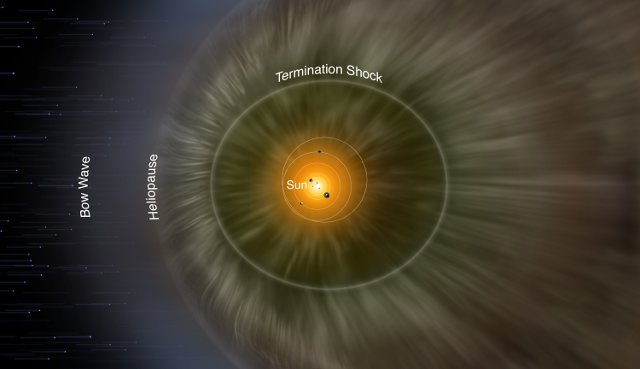
An article published in the journal “Astrophysical Journal Letters” describes a study that used data from NASA’s IBEX space probe and various simulations of the boundary of the magnetic bubble called the heliosphere, created by the flow of particles emitted by the Sun, to improve our knowledge of the interstellar magnetic field. In particular, this study sought to determine the strength and direction of the magnetic field outside the heliosphere to understand the forces acting in the galactic neighborhood.
NASA’s IBEX (Interstellar Boundary Explorer) space probe was launched in October 2008 precisely in order to explore the boundaries of the heliosphere. About four years ago it already revealed the composition of interstellar matter but the investigations have been going on because IBEX is still active.
A few months ago, the discovery of a “ribbon” of energetic neutral atoms by the IBEX space probe was announced. This helped scientists to explain some mysteries of the interstellar space boundaries. However, regarding the origin of the ribbon there was a hypothesis that needed testing.
This new study is based on the hypothesis proposed at the time to explain the origin of that ribbon, that those particles are actually originated from the Sun and are reflected inside the heliosphere. Part of the protons that are part of the solar wind are sent back as neutral atoms after a complex series of charge exchanges creating the IBEX ribbon. This theory is consistent with the space probe’s observations and with the simulations conducted indicating a process that takes from three to six years.
The detections carried out directly by the Voyager 1 space probe were important because it’s the only one in interstellar space. A mystery was the fact that it had crossed the border called “termination shock” at about 94 astronomical units (the average distance of the Earth from the Sun) from the Sun while its twin Voyager 2 had crossed it at 84 astronomical units. It’s approximately 1.5 billion kilometers (930 million miles) apart.
The difference was explained by the solar cycle, which determines differences in the intensity of the solar wind. The two Voyager probes carried out measurements almost three years apart, enough for the termination shock to shift so much. This result shows how much influence the various forces acting at the boundaries of interstellar space can have.
Using data collected by the Voyager and IBEX space probes, scientists are refining the action models of the solar wind to create better and better simulations. Putting it all together, they found confirmation to the theory of the origin of the ribbon at the edge of interstellar space. Step by step, we’re finding out what’s really out there.
