
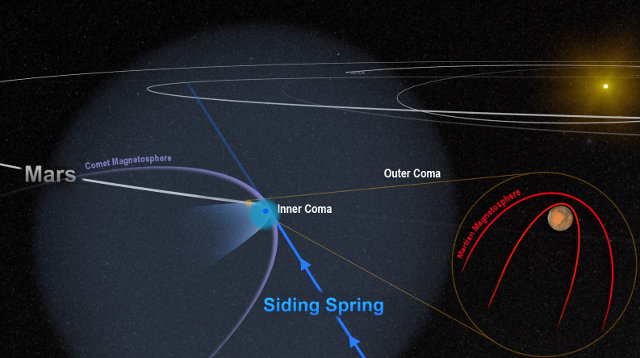
An article published in the journal “Geophysical Research Letters” describes the effects on the planet Mars’ magnetic field caused by the close passage of the comet C/2013 A1 Siding Spring in October 2014. Using data collected in that period by NASA’s MAVEN space probe it was possible to reconstruct the moments that were chaotic for the Martian magnetosphere with profound consequences even if temporary.
Mars’ magnetic field is very different from that of the Earth because it’s not generated by the planet’s core but is a result of the redirection of the solar wind around it thanks to the fact that the upper part of Mars’ atmosphere is composed of plasma. The consequence is that the particles forming the solar wind interact with the charged particles that make up the plasma and the electric currents that are produced form a magnetic field.
The comet C/2013 A1 Siding Spring is also surrounded by a magnetic field that has an origin similar to that of Mars. In this case, the plasma is generated in the comet’s coma, which in its approach to the Sun expanded up to one million kilometers (more than 600,000 miles) in every direction. Again, the interaction with the solar wind generated a magnetic field.
The October 2014 close encounter brought the comet C/2013 A1 Siding Spring at about 140,000 kilometers (about 87,000 miles) from Mars. The consequence is that the two magnetic fields clashed for several hours with the result that the comet’s more powerful one overwhelmed the planet’s wider but weaker one.
This effect was predicted so many instruments of the MAVEN space probe and those of other spacecraft orbiting Mars were turned off during the comet C/2013 A1 Siding Spring’s flyby to prevent any damage. However, some remained active such as the magnetometer, which allowed to collect data on the effects of the clash between the two magnetic fields.
The changes in Mars’ magnetic field were gradual, increasing with the comet C/2013 A1 Siding Spring’s approach. At the time of closest approach, the Martian magnetosphere was in chaos with its field lines pointing in different directions from their normal ones. The effects continued for hours after the comet moved away.
One of the MAVEN space probe’s goals is to understand the interaction between Mars and the Sun, therefore solar wind as well. The passage of the comet C/2013 A1 Siding Spring was compared to a short but powerful solar storm and probably also caused an increase in the gas that escaped Mars’ atmosphere. The Earth’s magnetic field is much more powerful so it wouldn’t suffer such intense effects but Mars doesn’t have that kind of shield and this has negative consequences.
