
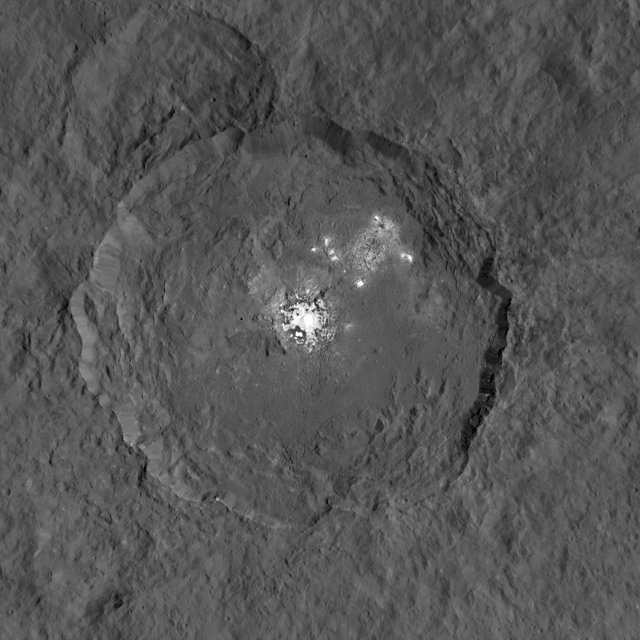
An article published in the journal “Monthly Notices of the Royal Astronomical Society” describes the detection of variations in the brightness of the famous white spots on the dwarf planet Ceres. Using the HARPS spectrograph at ESO’s La Silla Observatory in Chile they were observed showing for example a higher brightness during the day. One explanation is that they contain volatile materials that evaporate due to the sunlight.
In the last year we got used to reading news about Ceres related to the activity of NASA’s Dawn space probe, which just over a year ago entered the dwarf planet’s orbit. The data collected by Dawn led to propose the theory that the largest white spots, inside the crater called Occator, were due to the presence of salts. However, according to a team of Italian scientists things might be a little different.
Paolo Molaro of INAF-Trieste Astronomical Observatory, the lead author of this research, wondered about the possible measurable effects of the white from Earth. Ceres’ rotation determines an approach and a recession of the spots from Earth with measurable effects on the sunlight spectrum that is reflected. The measurements had to be carried out with very precise instruments because the generated Doppler effect is minimal.
HARPS (High Accuracy Radial Planet Searcher) is generally used in the search for exoplanets and in their study. However, its characteristics make it useful in the study of celestial bodies within the solar system as well, in this case the dwarf planet Ceres.
The researchers used HARPS a first time on July 30, 2015 with a sequence of 40 exposures 780 seconds each and a second time on August 26 with a sequence of 29 exposures 900 seconds each. On August 27 a third sequence was scheduled but due to bad weather it was possible to obtain only 5 exposures. Their analysis revealed surprising results because the changes in the spectrum were not only those due to the Doppler effect but there were other remarkable ones.
According to the researchers, these variations may be due to the presence of volatile materials that evaporate because of the sunlight when it’s day in the Occator crater. Among the possibilities there are ice water and hydrated magnesium sulphates. During the day, these materials sublimate and form a haze that greatly reflects sunlight. The amount of materials that form it could change continuously justifying the variations.
In short, the mysteries around the white spots on Ceres haven’t been solved for good, on the contrary this new research added some doubts about their composition though a salt is again considered. The Dawn space probe is mapping the dwarf planet from its lowest orbit and will keep on sending data for several more months. The observations from Earth can continue even after the end of NASA’s mission.
