
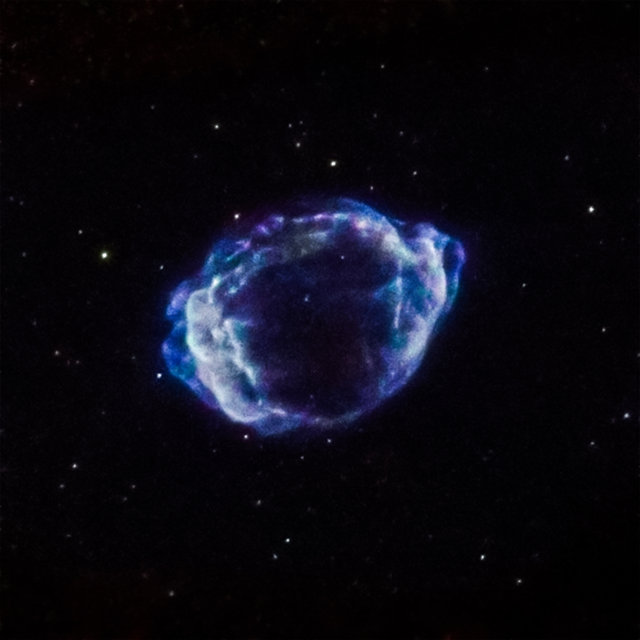
An article published in “Astrophysical Journal” describes the analysis of the supernova remnant G1.9+0.3, the youngest observed in the Milky Way. A team of astronomers from Harvard University used data collected by NASA’s Chandra space telescope and the VLA radio telescope to find evidence that it’s an explosion triggered by the merger of two white dwarfs, what is called a Type Ia supernova.
The supernova G1.9+0.3 was discovered by the VLA radio telescope in 1985 but only as a strong source of radio waves and its nature was established in 2008. According to the Chandra space telescope’s team, its distance is estimated at around to 27,700 light years from Earth. This means that actually the explosion occurred many thousands of years ago but its light started reaching Earth only a little over a century ago.
A scientific problem related to Type Ia supernovae – the on G1.9+0.3 belongs to – concerns the cause that triggers them. The hypotheses were the accumulation of materials around a white dwarf coming from a companion star or the violent merger of two white dwarfs. To try to understand the origin of G1.9+0.3 the researchers put together the data collected with the VLA and Chandra and analyzed how the remnants of supernova interacted with gas and dust surrounding the explosion.
The data in the archives of the observations made with the Chandra Space Telescope allowed to find the X-rays emitted by the supernova G1.9+0.3. The data in the VLA archives have instead allowed to find the radio waves emitted by G1.9+0.3. Putting together these data it was possible to find out in particular an increase in those types of electromagnetic emissions over time in the supernova remnant.
The data found match the theoretical predictions made by Sayan Chakraborti, who led the team that conducted this research, about a merger of two white dwarfs. It’s the first time confirmation of this possible cause of a Type Ia supernova are found. However, this doesn’t mean it’s the only cause.
Discovering the secrets of this kind of supernovae is important also because they’re the so-called “standard candles”. Put simply, these are objects that have a known luminosity therefore allow to calculate cosmic distances. If there are different causes for Type Ia supernovae their different percentages may change over time and they may not be so standard.
Almost exactly a year ago two articles were published, again in “Astrophysical Journal”, which expressed doubts on the brightness uniformity of Type Ia supernovae. That research was directly connected to the expansion of the universe calculations, one of the uses of these “standard candles”. This is one of the reasons why the research on these supernovae continue.

Permalink