
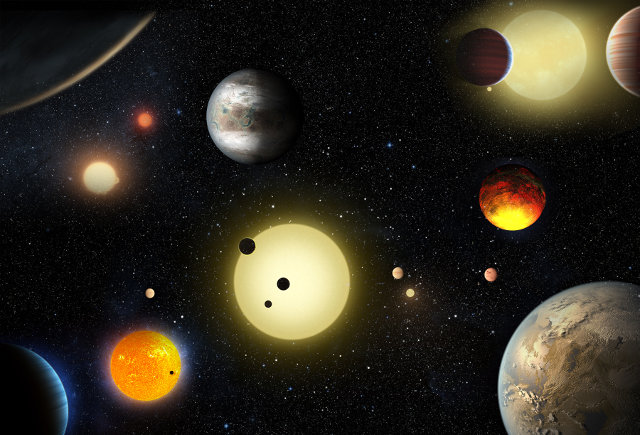
Yesterday, NASA held a press conference to announce that 1,284 exoplanets have been verified among the candidates discovered using its Kepler space telescope. It’s by far the largest number of planets added to the already long list of the known ones. An article on this discovery has just been published in “The Astrophysical Journal”.
In February 2014, NASA made an earlier big announcement about the verification of a series of exoplanets in one shot. The 715 exoplanets found thanks to the Kepler space telescope were an extraordinary event for the number but also because a statistical method was used that allowed to carry out an exam of an enormous amount of data to understand which of the many candidates were actually planets.
Again a statistical approach was used by NASA to analyze data of planets candidates existing in the catalog of the Kepler space telescope in 2015. NASA used a free / open source sofware called VESPA (Validation of Exoplanet Signals using a Probabilistic Algorithm) developed precisely to calculate the probability of false positive for transit signals of an exoplanet candidate.
There were 4,302 candidates and it turned out that 1,284 of those had a probability of more than 99% to be planets. It’s a level of probability close to certainty but there’s still a margin of error despite the great progress achieved in recent years in the study of exoplanets.
The issue of false positives is thorny. Sometimes other stellar phenomena were mistaken for a planet and only after a long time researchers realized their mistake. There are planets whose existence is currently disputed such as the alleged one in the Alpha Centauri system. Sometimes something is there but it’s a brown dwarf so the error is only in its correct identification.
In this latest research 707 candidates didn’t pass the requirements and could be brown dwarfs but also eclipses caused by binary stars or other astrophysical phenomena that left traces like those of exoplanets. 984 other candidates have been confirmed but those were exoplanets already verified with other techniques. In these cases, it’s a result that shows once again that this type of statistical analysis is valid.
1,327 candidates remain that haven’t reached 99% probability in the statistical analysis. Their nature is uncertain and it’s possible that in most cases they’re exoplanets too whose traces were not clear enough to satisfy all the requirements to pass the statistical exam. This means that they’ll require additional studies with other telescopes that take time because every candidate must be studied individually.
Almost 550 of the new verified exoplanets could be rocky, therefore super-Earths. Nine of them are orbiting in the habitable zone of their star so if they have an atmosphere similar to the Earth’s water on their surface can be in a liquid state. Surely those exoplanets will be studied in the next years, also with nex-generation telescopes.
Now more than 3,200 exoplanets have been verified and 2,325 of them were discovered by the Kepler space telescope. It looks like a huge number but is tiny if we think that the Milky Way contains at least 100 billion stars and Kepler observed “only” 150,000 of them. It’s a confirmation that the research on exoplanets is still at the beginning.
NASA created a video that shows the transit technique used by the Kepler space telescope to find traces of exoplanets. It’s a phenomenon similar to the planet Mercury’s transit that happened a few days ago but at distances of light years the traces are minimal and require very precise instruments to detect them.
