
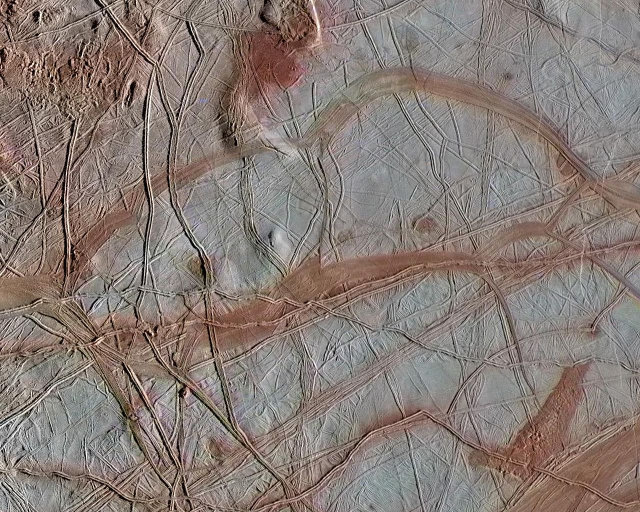
An article published in the journal “Geophysical Research Letters” describes a research on chemical characteristics existing in the underground ocean of Europa, one of the planet Jupiter’s big moons. A team of scientists at NASA’s Jet Propulsion Laboratory team (JPL) compared the potential to produce hydrogen and oxygen with that of the Earth, concluding that they’re comparable.
Europa has long been the focus of many scientists’ interest for the presence of an underground ocean in which there’s salty water in its liquid state. Several studies are trying to figure out if there are the necessary elements to support life forms similar to those on Earth and according to Steve Vance, the lead author of the paper describing this new research, a key lies in the proportions of the chemical elements in that ocean.
According to Steve Vance and his colleagues at JPL Europa’s rocky interior may be more complex and similar to Earth than it was thought. The team is studying this moon’s underground ocean using methods developed to understand the movement of energy and nutrients in the Earth’s systems. The cycle of oxygen and hydrogen in the ocean of Europa is crucial in its chemical activities and for the possible forms of life, just as happens on Earth.
The JPL team calculated how much hydrogen could be produced in Europa’s ocean when the ocean water reacts with the rocks that make up its floor. This reaction is called serpentinization, a process in which water percolates into the spaces between mineral grains and reacts with the rock to form new ones at the same time releasing hydrogen.
Oxygen could arrive from the icy crust over the ocean, which covers the entire surface of Europa. Strong radiation coming from Jupiter break the ice water molecules generating molecular oxygen and other oxidizing molecules that end up in the ocean and can combine with hydrogen coming up from its floor.
On Earth, the fractures in the oceanic crust can reach a depth of 5 or 6 kilometers (3 or 4 miles). According to the researchers, on Europa they can go 25 kilometers (15 miles) deep. The consequence is that chemical reactions may occur at a deeper fraction of the ocean floor.
To better understand the similarities between the oceans of the Earth and that of Europa, we’d need to know whether in Jupiter’s moon’s underground there are volcanic or hydrothermal activities. They could make the ocean waters enriched with minerals circulate favoring those elements’ cycles. Evidence of hydrothermal activity on Enceladus, a moon of Saturn in many ways similar to Europa, raised the hopes that in its ocean there are life forms.
Other factors affect the conditions in the ocean of Europa such as its acidity. It’s determined by the presence or not of volcanic activity but also by the rocks temperature, which influences the ease with which they fracture. There are enough data to figure out the actual ocean conditions and in this research several of them have been inferred using various models.
Oxygen and hydrogen are key elements but the JPL team also intends to study the cycles of the other most important elements in the ocean of Europa: carbon, nitrogen, phosphorus and sulfur. Those are also other elements crucial to life forms similar to ours so extend the research to them is important.
This type of study will be helped by the NASA mission planned for the next decade. A space probe will be sent into Jupiter’s system exactly with the aim to closely study Europa with a series of flybys. The data that will be collected could at last answer questions about the possibility of Europa to host life forms in its ocean.
