
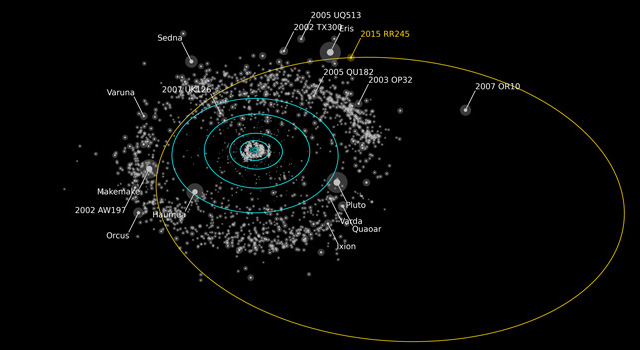
An international team of astronomers discovered the dwarf planet identified for now only as 2015 RR245. Using the telescope on Mount Maunakea, Hawaii, as part of the OSSOS survey, they found 2015 RR245, whose orbit is in the Kuiper belt, the area of the solar system beyond Neptune where there are many icy celestial bodies.
The dwarf planet 2015 RR245 was identified in February 2016 by examining the images taken in September 2015 during the OSSOS survey. That’s an international collaboration involving nearly 50 scientists from institutes and universities around the world. The aim is to reconstruct the history of the solar system beyond the planet Neptune by collecting data about the objects orbiting in that area. The observation of the Kuiper belt may lead to the discovery of new objects, as in this case.
The diameter of the dwarf planet 2015 RR245 has been estimated at around 700 kilometers (about 435 miles), which means it’s a bit smaller than Ceres. In the Kuiper belt there are 17 objects larger that that so this discovery is not at the level of that of a planet or at least of a dwarf planet the size of Pluto or Eris. However, each object discovered out there can tell us something more about the history of the solar system.
When the solar system was just born, there were probably a lot of dwarf planets and planetoids but that means that there were also many collisions. Most dwarf planets were destroyed and a part may have been thrown out of the solar system by the gravitational effects of the giant planets. Each Kuiper belt object that survived that phase is like a fossil of that era.
The information on the dwarf planet 2015 RR245 are very limited and even its orbit was estimated in a way still not very accurate. Its year is estimated to be around 700 Earth years and its orbit seems highly elliptical. For some centuries, its distance from the Sun was more than 12 billion kilometers (almost 7.5 billion miles) but now it’s approaching its perihelion, the closest point to the Sun. Close is a big word considering that it’s estimated at 5 billion kilometers (about 3.1 billion miles) and it should reach it around the year 2096.
Now that the dwarf planet 2015 RR245 has been identified it will be possible to study it with other telescopes and sooner or later it will be given a real name. Putting together the information about it, astronomers will be able to determine much more accurately its characteristics. Lately many people hope for the announcement of the discovery of a new full-fledged planet but the clues about its existence are only indirect and can be explained in various ways. 2015 RR245 exists and will give us more information about an area of the solar system we’ve been learning about only recently.
