
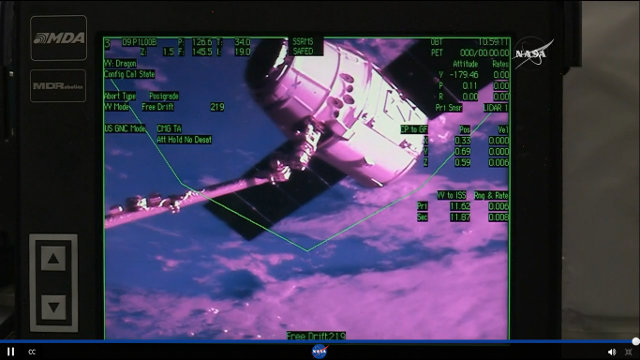
A little while ago the SpaceX Dragon spacecraft was captured by the robotic arm Canadarm2 on the International Space Station. Jeff Williams, assisted by his colleague Kate Rubins, managed the operation then started moving the Dragon to the berthing point at the Harmony module. The cargo spacecraft blasted off last Monday.
The approach of the Dragon spacecraft to the International Space Station follows a procedure that has become routine but remains long and delicate. The Station’s safety is the top priority so every little step of the Dragon gets checked. Only if all goes well in the spacecraft’s position and velocity they proceed with the next step and in case of any problems can be aborted at every step.
Tomorrow the crew of the International Space Station will open the Dragon spacecraft’s hatch and will start unloading its cargo. Generally those operations last about a week but this time the Dragon came a day after another freighter, the Russian Progress MS-3. Consequently, the operations will go on much longer than usual.
The Dragon will remain docked to the Station for a few weeks since it’s scheduled to leave on August 29, 2016. Over the next month, a series of experiments and other items to take back to Earth will be loaded on it, which is the only cargo spacecraft able to return to Earth intact.
The Dragon will leave the International Space Station with its new cargo. The CRS-9 mission will be completed with its descent into the Pacific Ocean, off the coast of California. This last phase is important as well because various in-depth analyzes of samples can only be performed in specialized laboratories on Earth.
For SpaceX it’s important that its missions have returned to normal. All the cargoes transported to the International Space Station are important but the delivery of the International Docking Adapter-2 (IDA-2) was really needed after IDA-1 got lost in the destruction of the Dragon at the beginning of the CRS-7 mission in June 2015.
IDA-2 is a key component of the new docking system that will be used by the new American spacecraft that will enter service in the coming years. The work to accomodate the Station’s Harmony module are already late because of the loss of IDA-1 but now NASA can schedule the IDA-2 assembly operations.

Permalink
Permalink