
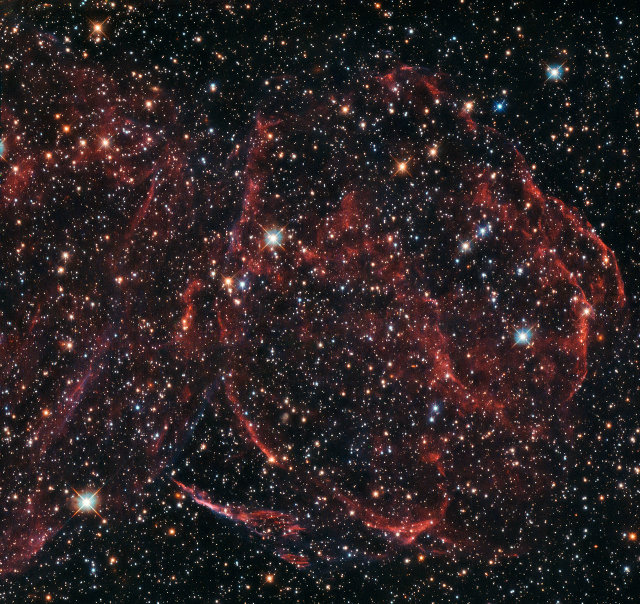
A photograph taken by the Hubble Space Telescope shows the remains of a star that died long ago. Those are wisps of ionized gas that still emit a faint glow, the last product of the immense energy generated in a Type Ia supernova. These supernova remnants called DEM L316A are located in the Large Magellanic Cloud, a satellite galaxy of the Milky Way, about 160,000 light-years away from Earth.
One of the causes considered possible for a Type Ia supernova is a white dwarf that steals gas to its companion star. This increases its mass until it reaches a critical level that triggers an explosion, the one called a Type Ia supernova. A possible case of this type is given by the so-called Tycho supernova though its nature is still under study. The one that generated DEM L316A, also known as SNR J0547.4-6941 and WCD97 Shell, might have that origin as well.
The supernova generates a huge amount of energy that physically ejects the star’s outer layers into space at extremely high speeds. These layers of gas are the ones that generate the remnants we see today because they heat up when they pass through interstellar materials with the consequence that they ionize and emit a faint glow.
The Hubble Space Telescope’s Wide Field Camera 3 (WFC3) instrument detected the glow emitted by the wisps that make up DEM L316A at infrared and optical frequencies. Four filters were used in the observations: near infrared, blue and two green filters. By assigning different colors to each monochromatic image associated with an individual filter it was possible to obtain the published image’s color.
The study of supernova remnants allows to evaluate the long-term consequences of these catastrophic events. After a period of very intense brightness, the materials projected outside travel in space. Their pressure on gas clouds that can be far away can trigger the birth of new stars and the chemical elements created in a supernova can become part of new planets. Type Ia supernovae still require studies to understand their mechanisms so cases such as DEM L316A are useful to scientists and give us spectacular images.
