
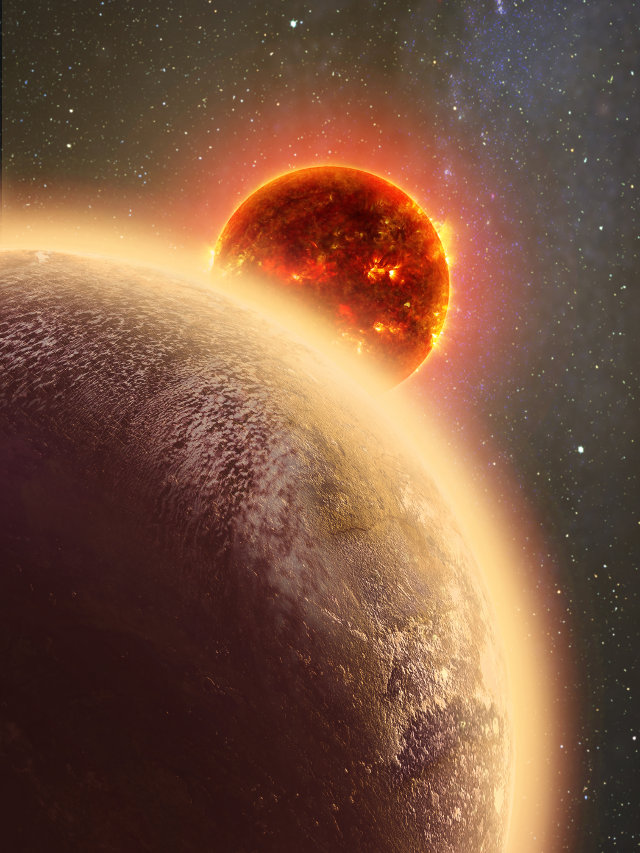
An article accepted for publication in “The Astrophysical Journal” describes a research on the exoplanet GJ 1132b, taken as an example of a rocky planet orbiting close to a red dwarf star. A team of astronomers led by Laura Schaefer of the Harvard-Smithsonian Center for Astrophysics (CfA) used computer models to simulate the evolution of that type of planet’s atmosphere concluding that could be thin and contain oxygen.
The star GJ 1132, about 39 light years from Earth, is about 20% the size of the Sun and emits a light that is only 0.1% of the Sun’s. The exoplanet GJ 1132b, or Gliese 1132b, was discovered in 2015 thanks to the MEarth Project, a robotic observatory that aims precisely to look for extrasolar planets around red dwarfs. Its distance from its star is only 2.2 million kilometers (about 1.4 million miles) and its year lasts only 1.6 Earth days.
Although the energy emitted by its star is relatively weak, the planet GJ 1132b’s is so close to it that the temperature on its surface is estimated at around 230° Celsius (450° Fahrenheit). After its discovery, further observations with the Magellan Clay telescope and the HARPS spectrograph allowed to estimate the size of this planet, which turned out to be slightly bigger than the Earth, and its mass, which appears to be 60% greater than the Earth’s.
The planet GJ 1132b’s characteristics might make it look like Venus but the doubt remained about its atmosphere’s characteristics. The CfA team tried to simulate the evolution of the atmosphere of a planet of that type assuming that it initially contained water vapor. The proximity to its star would generate a very strong greenhouse effect and at the same time a considerable ultraviolet radiation that would break water vapor into hydrogen and oxygen.
The gases in the hot atmosphere of GJ 1132b would be dispersed in space but this process would be much faster for hydrogen than for oxygen. Another portion of oxygen could be absorbed by the covered surface in magma because of its high temperatures. For these reasons, over time the presence of oxygen in the atmosphere could get very low and now there might be only a few amount or even nothing.
Some next-generation telescopes might be able to study the planet GJ 1132b’s atmosphere to test the computer models applied by the CfA team. Oxygen is particularly searched in exoplanets’ atmospheres because it could be an indication of the presence of life forms, even if a research published in 2015 proposed processes of oxygen generation other than biological. Exoplanets such as GJ 1132b are a different case because of the conditions impossible for life forms of types we know.
The study of exoplanets such as GJ 1132b may also help understand better what happened on Venus and perhaps even the other way around is true. A research published in June 2016 proposed an explanation to the loss of water that existed on Venus, a process that could also have happened on planets in other solar systems. Those are research that will help scientists figure out which rocky exoplanets are potentially habitable and which ones are similar to Venus.

Permalink