
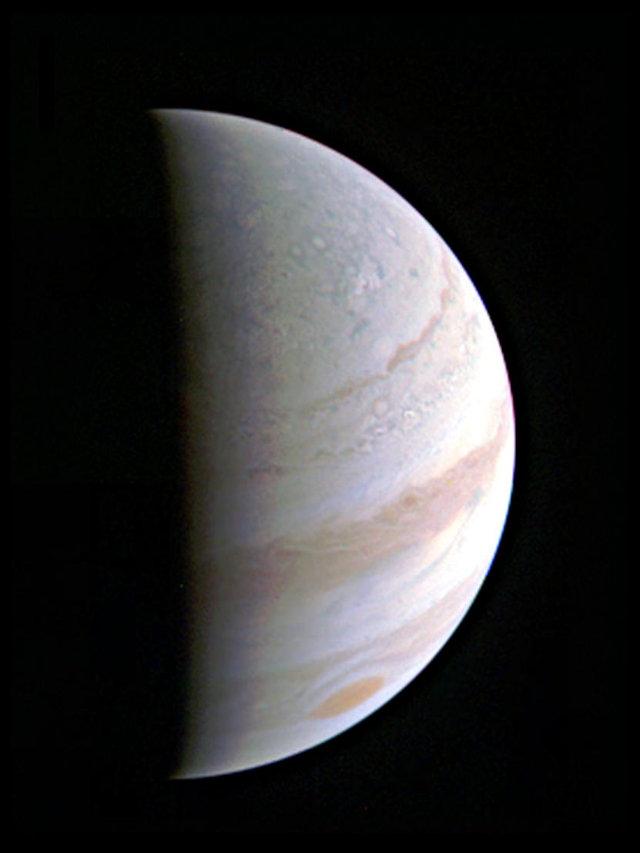
Yesterday NASA’s Juno space probe completed its first Jupiter flyby. At approximately 13:44 UTC it flew just 4,200 kilometers (2,600 miles) above the Jovian clouds, the minimum distance scheduled throughout its primary mission. At that point, Juno was traveling at about 208,000 km/h (130,000 mph) compared to the planet. This is the first of 36 flybys planned in the two and a half years of its primary mission.
The Juno space probe entered Jupiter’s orbit on July 4, 2016 but during that maneuver its scientific instruments were turned off to prevent the shock of entering the planet’s very powerful magnetic field from damaging them. Juno entered an orbit that minimizes contact with the belts similars to the Earth’s Van Allen belts, however some of the instruments are expected to be rendered unusable by the radiation that will hit them during its mission.
Nick Nybakken, Juno project manager at NASA’s JPL, stated that the flyby was a success and the first telemetry data received at its end indicate that everything worked as expected. It was the first time that all the probe’s scientific instruments were active and focused on Jupiter to start collecting data. It will take a few days to send all the data to NASA and then their analyzes will begin.
We’re still far from the 15 months required for the New Horizons space probe to send all the data collected on the dwarf planet Pluto and its moons. These are two very different missions: New Horizons was intended to discover in a single flyby a dwarf planet that until a year ago was little more than a bunch of pixels while Juno is orbiting Jupiter and aims to deepen our knowledge of a relatively nearby planet that was already visited by various space probes and is much easier to study with telescopes.
For these reasons, the Juno mission is based above all on various instruments and has only JunoCam to take photographs. That’s a mini-telescope with a visible light camera included in the set of instruments especially for educational purposes and for the audience who can appreciate pictures more than all the other data that require some knowledge to understand them.
However, JunoCam will also be useful to take photographs of Jupiter from an orbit that provides a point of view different from those of the previous space probes. This will allow it to get images of the planet’s atmosphere and its poles better than those available so far. The first ones should be published from the next week.
