
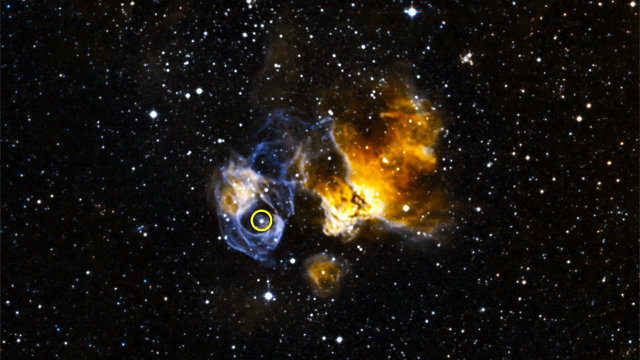
An article published in “The Astrophyisical Journal” describes the discovery of the first gamma-ray binary found outside the Milky Way, called LMC P3. A team of researchers led by Robin Corbet at NASA’s Goddard Space Flight Center used the Fermi space telescope to discover this couple in the Large Magellanic Cloud formed by a giant blue star and a companion that might be a neutron star or a black hole that are interacting producing cyclic gamma-ray emission.
Gamma-ray binaries are characterized by the fact that one of the two companions is a neutron star or a black hole and emit most of their energy in the form of gamma rays. So far only a small amount of gamma-ray binaries were discovered and all in the Milky Way. LMC P3 was instead located in the Large Magellanic Cloud, a satellite galaxy of ours approximately 163,000 years light from Earth.
After the discovery of LMC P3, which occurred in 2015, Robin Corbet’s team examined this gamma-ray binary using other space and on ground-based telescopes that allowed to observe it at very different wavelengths: in X-rays using NASA’s Swift space telescope, at radio wavelengths with the Australia Telescope Compact Array near Narrabri and in visible light using the 4.1-meter Southern Astrophysical Research Telescope on Cerro Pachón in Chile and the 1.9-meter telescope at the South African Astronomical Observatory near Cape Town.
All these observations allowed to collect various observations of LMC P3, starting from the gamma-ray emission cycle of 10.3 days. The radio and X-ray emissions are out of phase with one that reached its peak when the other touches the minimum and vice versa. The radio emissions have instead the same period as gamma-ray emissions.
The X-ray source was already found in 2012 using the NASA’s Chandra X-ray Observatory. The researchers identified the remains of a supernova, named DEM L241, which had a core that subsequently collapsed into a neutron star or a black hole. They also noticed the existence of a companion that survived the nearby supernova.
Unfortunately our position with respect to the gamma-ray binary LMC P3 makes it difficult to understand the collapsed object’s exact nature. The two objects’ orbital motion instead allowed estimating at least approximately their masses: the blue giant has a mass between 25 and 40 solar masses with a surface temperature of more than 33,000° Celsius (60,000° Fahrenheit), the collapsed object has a mass at least twice the Sun’s.
For all we know gamma-ray binaries are rare, more than astronomers expected before the launch of the Fermi Space Telescope. Finding one in another galaxy after having found very few of them in the Milky Way was surprising, a further reason to keep on studying the known ones by combining the observations of various instruments.
NASA created a video with the animation of the gamma-ray binary LMC P3.
