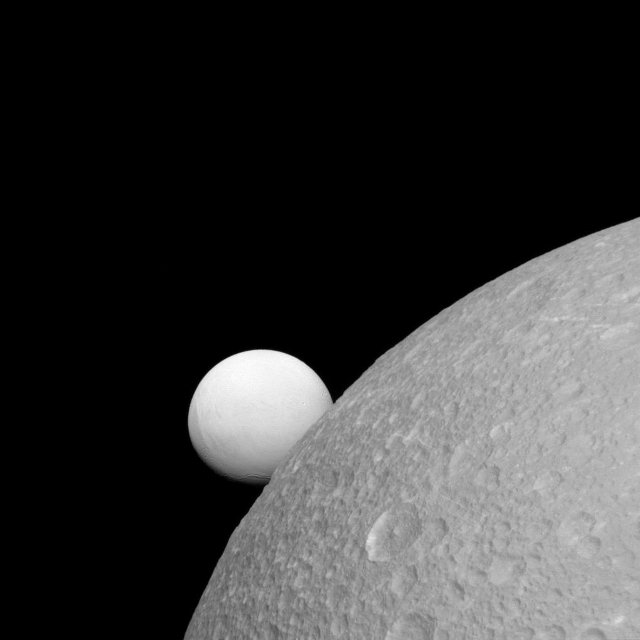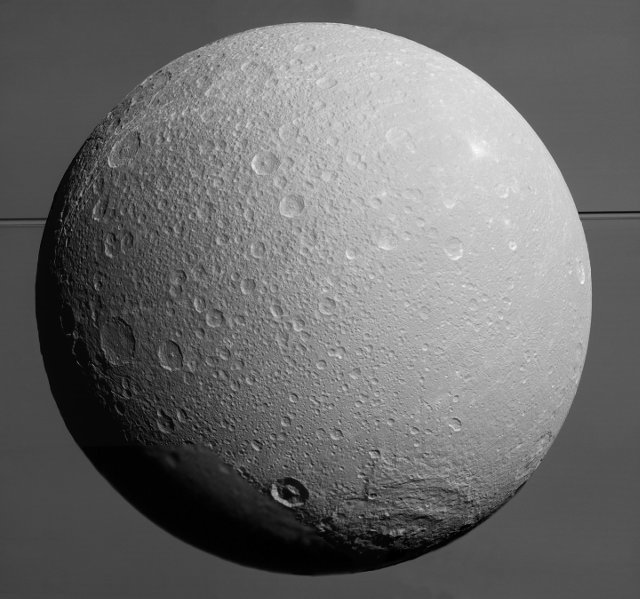
An article published in the journal “Geophysical Research Letters” describes a research on Dione and Enceladus, two of the planet Saturn’s moons. Using data collected by the Cassini space probe, Mikael Beuthe, Attilio Rivoldini and Antony Trinh of the Royal Observatory of Belgium in Brussels calculated in a new way the two moons’ icy crust thickness concluding that Dione has an underground ocean as well.
The Cassini space probe has been studying Saturn and its moons for several years. From the beginning of the mission, Titan was to enjoy special attention but the discovery of an ocean beneath the surface of Enceladus and geysers at its south pole made the mission even more interesting. Only last year scientists found an oscillation phenomenon by Enceladus, called libration, caused by the fact that its crust isn’t directly connected with its inside. This led to the creation of new models to try to better understand its structure.
According to older studies, Enceladus’ icy crust was very thick. However, new studies that took into account this moon’s libration showed that its crust must be thinner in order to justify its rotation. This new research is based on the latest results and the application of updated models may also help to understand the structure of Dione, which has a libration that is too small to be detectable by Cassini. The news is that these moons’ icy crusts were modeled as global icebergs submerged in water.
Dione has a diameter that is more than double that of Enceladus and is composed mainly of water ice. According to this new research, 100 kilometers below the surface water could be liquid, forming an ocean several tens of kilometers deep. By comparison, Enceladus’ icy crust could have in some places a thickness of just a few kilometers.
Dione’s average density indicates that it must have a rocky core. If there’s really an underground ocean, it’s in contact with its core, which would provide a possible source of minerals and energy. As for Enceladus, those are fundamental ingredients for the possible development of life forms.
There are some projects to study Saturn’s moons after the end of the Cassini mission to try to discover more about Enceladus’ underground ocean. If Dione has one as well, the ice shell that covers it is too thick to hope to probe it but being able to make sure that it exists would be a breakthrough.