
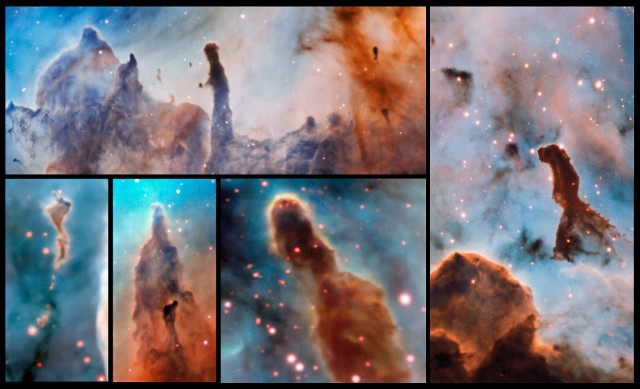
An article accepted for publication in the journal “Monthly Notices of the Royal Astronomical Society” describes a research on the large columnar structures in the Carina Nebula. A team led by Anna McLeod, a PhD student at ESO, used the MUSE instrument installed on ESO’s VLT (Very Large Telescope) to examine these structures that have been nicknamed “pillars of destruction” for certain similarities with the “Pillars of Creation” photographed by the Hubble space telescope.
The different structures reminiscent of spires and columns in the Carina Nebula are vast clouds of dust and gas 7,500 light years away from Earth. It’s a kind of incubator for new massive stars, however they’re slowly eating away the clouds that generated them. In fact, they produce large amounts of ionizing radiation that are stripping the cloud’s atoms of electrons but so far it was very hard to observe that interaction.
The MUSE (Multi Unit Spectroscopic Explorer) instrument combines spectroscopy and photography to observe large astronomical objects in a complete way in one shot. It allows to create thousands of the nebula images at the same time, each at a different electromagnetic radiation’s wavelength. This allows astronomers to map the materials’ chemical and physical properties in different areas of the nebula.
The researchers analyzed the effect of ionizing radiation on the nebula’s pillars, a process called photoevaporation, which occurs when the gas is ionized and dispersed. Observing the effects of this process, which include the pillars’ mass loss, it was possible to deduce the culprit. There was a clear correlation between the amount of ionizing radiation emitted by the nearby stars and the pillars’ dissipation.
The clouds of dust and gas that make up the nebula are very diffuse even if the pillars in the images seem dense. Radiation and stellar winds from the massive newborn stars might create more dense areas triggering the creation of more stars. In essence, what looks like a cosmic calamity could instead be a useful phenomenon with dust and gas that are used in a star formation that could be more efficient than it seemed initially.
In the Eagle Nebula, where there are the “Pillars of Creation” depicted in the iconic photos taken by the Hubble Space Telescope there’s also a star incubator. Studying these nebulae helps to understand the cosmic cycles of star birth and death because nebulae such as Carina and Eagle are a part of it.
