
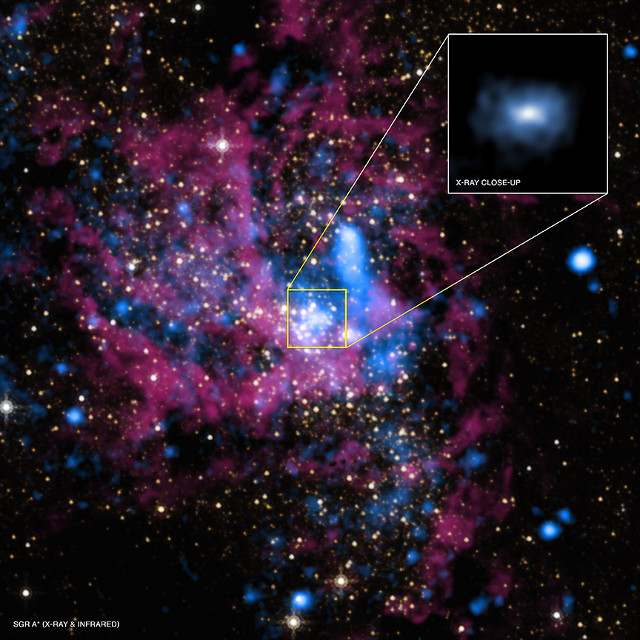
An article published in the journal “Physical Review Letters” describes a research on Sagittarius A*, the supermassive black hole at the center of the Milky Way. A team of scientists from the University of Princeton and the US Department of Energy’s Princeton Plasma Physics Laboratory (PPPL) developed a new method to create a model of the accretion disk which feeds Sagittarius A*.
Galaxies usually have a supermassive black hole at their center and the Milky Way’s one was called Sagittarius A* because it’s located in the Sagittarius constellation. In the image the X-ray detection taken by NASA’s Chandra space telescope are shown in blue while the Hubble Space Telescope infrared ones are shown in red and yellow. In the inset there’s a close-up of Sagittarius A* at X-rays.
The mass of Sagittarius A* is estimated to be four million solar masses and is surrounded by a so-called accretion disk formed by gas ionized that’s become plasma that is slowly swallowed. This activity, however, generates an amount of radiation lower than expected.
The plasma that is swallowed by a supermassive black hole is a really extreme event that can generate remarkable amounts of electromagnetic radiation. The extreme cases are some of the most energetic sources of the universe, called active galactic nuclei. Sagittarius A* is far from those extremes, even too far, so this new research was conducted to create a better model that explains its behavior.
The starting point of the new study is that the accretion disk of Sagittarius A* is so hot and diluted that the trajectories of the electrons and protons contained in the plasma rarely intersect. Generally the motion of the plasma which forms the accretion disk is treated as that of a macroscopic fluid but this type of model can not describe the process that makes the plasma of the accretion disk unstable until it’s swallowed.
In this new research a model that uses a new approach was developed that physicists call kinetic to systematically trace the motion of each collisionless particle. It’s a complex approach developed using the Pegasus software, developed at Princeton by Professor Matthew Kunz, the lead author of the research, along with colleagues including James Stone, another of the authors.
The new model could help to better understand the behavior of Sagittarius A* producing better predictive models of the emissions that come out of it. This model will have to be tested by comparing its results with actual observations of the area around the supermassive black hole. For now these are possible for example with the Chandra space telescope.
In 2017 the Event Horizon Telescope is scheduled to be activated, which will allow to make new observations at radio frequencies. It’s a system that will combine a number of radio telescopes located in different places of the world by making them work together as if they were a single huge telescope. The goal is exaclty to observe the area around Sagittarius A*.

Permalink
4 million solar masses! That’s heavy tho relatively small. Presumably mass is increasing as more material gets absorbed. At what rate is this increase?
Where does the material for the accretion disc originate? Presumably nothing is safe once it comes within range: planets, suns etc all will collapse into their molecular components.
Permalink
Honestly I don’t know if anyone tried to assess its mass increase. The accretion disk is formed by gas and dust attracted by the black hole’s gravity, materials floating near the Milky Way’s central area that arrive too close to the supermassive black hole and are doomed to approach it until they get swallowed.
Permalink
quanta bellezza c’è nell’universo! spesso ce ne dimentichiamo!!
Permalink
Davvero trovi spettacoli cosmici incredibili!