
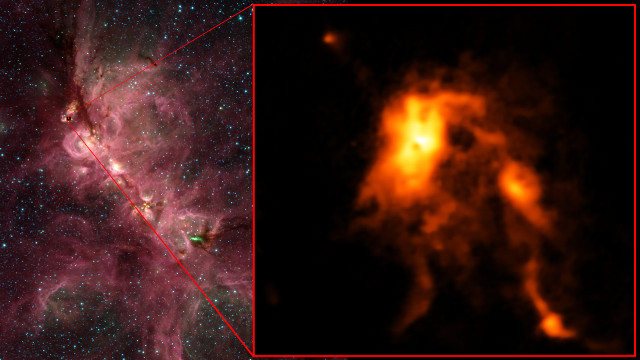
An article published in “Astrophysical Journal Letters” describes the study of a protostar indicated as NGC 6334I-MM1 which increased its brightness 100 times. A team led by astronomer Todd Hunter of the National Radio Astronomy Observatory (NRAO) discovered this transformation by comparing new observations carried out with the ALMA radio telescope with other ones previously carried out with the SMA radio telescope.
The protostar NGC 6334I-MM1 is still forming inside the Cat’s Paw Nebula, also known as NGC 6334. It’s a stellar protocluster, a kind of nursery that consists of a dust and gas cloud condensing to form various stars. For this reason, in 2008 observations were conducted with the SMA (Submillimeter Array) radio telescope in Hawaii of the nebula region occupied by the protostars, which was called NGC 6334I.
Normally star formation process is likely to be slow and steady but there are cases where it can have violent periods. In the years following the observations of the NGC 6334I area with SMA the ALMA radio telescope was inaugurated and in 2015 the researchers started a number of new observations with the new instrument discovering a significant increase in brightness.
Today the whole area is about four times brighter than less than a decade ago at millimeter wavelengths, which means that the protostar NGC 6334I-MM1 is almost one hundred times brighter than in the first observations. First of all, the researchers verified that this change wasn’t the result of differences in the two radio telescopes they used or data processing errors but their checks confirmed that NGC 6334I-MM1 really had a strong increase in brightness.
Further confirmation came from an outside source, the Hartebeesthoek Radio Astronomy Observatory in South Africa, which in 2015 was used to monitor masers, which are generated by natural sources, in that region. The observations showed that at the beginning of 2015, just months before the first observations with ALMA, there was a spike in maser emissions. A peak like that is what is expected when a protostar is going through a strong growth.
All this confirms that the formation of a star can go through violent events and being able to observe them will allow to establish their causes. The hypothesis made by the researchers is that a mass larger than normal of materials ended up in the accretion disk of the protostar NGC 6334I-MM1 and after some time was swallowed significantly increasing its mass and its brightness.
Another consequence was an increase in the surrounding gas’ heating which resulted in an increase of its brightness as well. Similar events were observed at infrareds but it’s the first time that a detection at millimeter wavelengths was obtained.
All this activity has a strong influence on the nebula because a significant amount of gas was absorbed and the strong growth of the protostar NGC 6334I-MM1 generated emissions that are changing the shape of the surrounding area. The image shows that the Cat’s Paw Nebula’ size is much bigger than the protostar but there’s a region within it that changed dramatically representing a really interesting example of one of the early stages of stellar evolution.

Permalink