
An article published in the journal “Icarus” describes a research on rainfall on the young planet Mars. Geologists Robert Craddock of Smithsonian Institution and Ralph Lorenz of Johns Hopkins University Applied Physics Laboratory showed how the changes in the Martian atmosphere caused an increase in rainfall, which had effects on the surface of the planet similar to those we see on Earth.
When the planet Mars was young, climate conditions were similar to those on Earth, thanks to a dense atmosphere that generated a pressure much greater than the current one. Some studies suggest that initially it had a magnetic field that at some point ceased, leaving the planet with no defense from the solar wind that over time stripped most of that atmosphere.
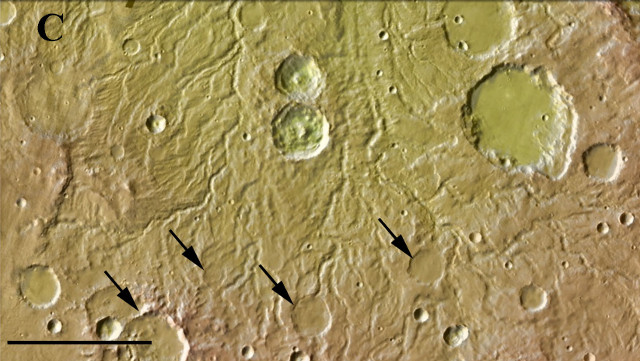
As long as Mars’ atmosphere was dense enough, there was liquid water on the planet’s surface and the geological traces also show craters and valleys generated by rainfall-induced erosion. In fact, in that ancient era it was raining enough to leave traces after a few billion years. So far, no one has studied Martian rainfall with their changes over time but now Robert Craddock and Ralph Lorenz have decided to apply Earth rainfall analysis methods.
The study of rain is connected to that of the atmosphere, which in the case of Mars has changed over time influencing the rain. The atmospheric pressure affects the size of raindrops and the force of their fall, as a result the gradual drop in pressure resulted in drop growth and a greater force in their fall. At some point the combination of drop size and force become enough to penetrate the soil and thus altering the craters but also generating enough erosion to create valleys.
The drop in atmospheric pressure is a process that went on slowly over millions of years but the long-term consequences have been remarkable. The average pressure on the Earth’s surface is 1 bar, that on Mars’ surface at its maximum was 4 bars, a condition where raindrops had a diameter not exceeding 3 millimeters and could not penetrate the soil.
Over time, the atmospheric pressure dropped to 1.5 bar, a condition where raindrops could reach a diameter of 7.3 millimeters versus 6.5 millimeters on Earth. The lower gravity force on Mars made those rains less intense than the Earth’s ones but the raindrops were able to penetrate into the ground causing various erosion phenomena.
There are information that could be impossible to calculate such as the height that the clouds could reach in the Martian atmosphere during those times. The researchers used again the parameters of rainfall on Earth. There are some approximations but this research provides a picture of rain’s history on Mars.

Permalink