
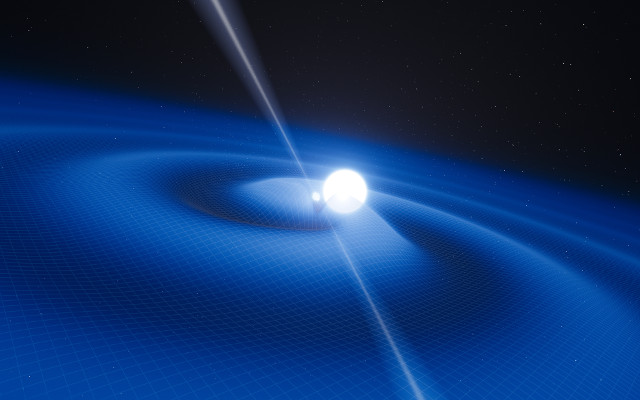
An article published in the journal “The Astrophysical Journal” describes the calculation of the maximum mass that a neutron star can reach. A team of astrophysicists from the Goethe University Frankfurt exploited what are considered universal relations between stars of that type and data collected in the event that saw the merger of two neutron stars observed at both gravitational waves and electromagnetic waves to establish that a non-rotating neutron star can’t exceed 2.16 solar masses.
Neutron stars are one of the possible type of remnants of a star after the end of its normal life and its explosion in a supernova. These objects are incredibly dense and their average mass is about 1.4 solar masses enclosed in a sphere with a diameter of about 12 kilometer (about 7.5 miles). There are some more massive ones such as PSR J0348+0432, which has a mass measured in 2.01 solar masses, which has a white dwarf as a companion that is enormous in comparison.
Potentially, the mass of neutron stars can increase over time if something else ends up in their gravitational field at insufficiently high speeds. However, there’s a maximum limit beyond which the collapse of the matter composing that type of star reaches levels that turns it into a black hole.
Professor Luciano Rezzolla of the Frankfurt Institute for Advanced Studies (FIAS) and professor of theoretical astrophysics at the Goethe University, together with his students Elias Most and Lukas Weih, calculated that limit. One of the bases of this study is the universal relations between neutron stars that in very simple words tell us that all the stars of that type are similar so their properties can be expressed in terms of dimensionless quantity.
This approach was used in 2016, when Rezzolla and another student, Cosima Breu, completed another study concerning neutron stars. In that case the calculations concerned the maximum limit for the mass of rotating neutron stars, higher than non-rotating ones because the additional centrifugal force can balance the additional gravity.
The result of this new research is a theoretical model that describes the dense matter inside a star and provides information on its composition at various depths. This left some uncertainties and the data collected in the event indicated as GW170817, which saw the merger of two neutron stars observed at both gravitational waves and electromagnetic waves, were crucial.
Gravitational wave astronomy and astrophysics are a very new branch of these sciences but they’re already providing the first results. Understanding what happens to matter in extreme states such as in the compression existing in neutron stars gets also combined with certain studies of particle physics. Basically, a further connection between the macrocosm and the microcosm.
