
An article to be published in the journal “Monthly Notices of the Royal Astronomical Society” describes the study of the supernova ASASSN-15no. A team of astronomers, especially from the National Institute of Astrophysics in Padua, Italy, led by Stefano Benetti used a number of telescopes to observe an explosion that was initially hidden by a thick layer of gas and dust ejected by the progenitor star a few years before. For this reason, the astronomers have called it a supernova that plays hide and seek but in the end it popped out and was at least ten times brighter than normal.
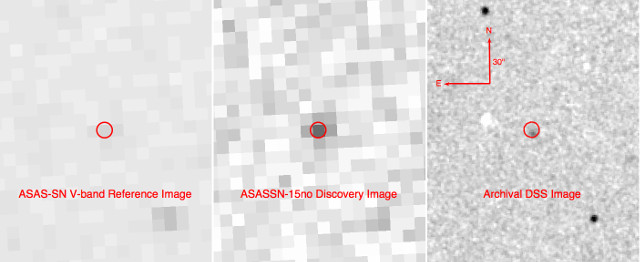
On August 3, 2015 the ASAS-SN (All Sky Automated Survey for SuperNovae) project, an international collaboration that uses a network of telescopes spread all over the world also to search for supernovae, discovered a new transient source in the Galaxy SDSS J153825.20 +465404.1 that could be a supernova. That source, called ASASSN-15no, was subsequently observed by a number of telescopes that made it possible to establish that it was indeed a supernova, even if of a particular nature.
Normally, when a massive star consumes its hydrogen but also other heavier elements and its nucleus collapses for good, it explodes into a supernova which is immediately very bright. In the case of ASASSN-15no, however, the astronomers didn’t see the explosion but the release of energy from a shell of gas and dust heated and accelerated as a result of the collision with materials ejected from the supernova.
Due to their expansion, the external materials became less dense and after about a year the radiation of the supernova remnants, emitted by layers internal and close to the explosion, became dominant. Until then, the appearance of the supernova was typical of the collapse of a massive star rich in hydrogen but later it became that of a star almost completely without hydrogen, called in the jargon Ic.
According to the astronomer’s reconstruction, the ASASSN-15no supernova involved the exploding star but also a very close companion very close. This second star lost its outermost layers, which got torn from it by its companion, which got wrapped up in them. At that point, the star collapsed and exploded but the event was not visible due to the shell that enveloped it.
The telescopes used to observe the visible consequences of the ASASSN-15no supernova allowed to collect a lot of information even without seeing the actual explosion. However, these data are useful to understand the processes that lead to the collapse of a star and to all its consequences.

Permalink