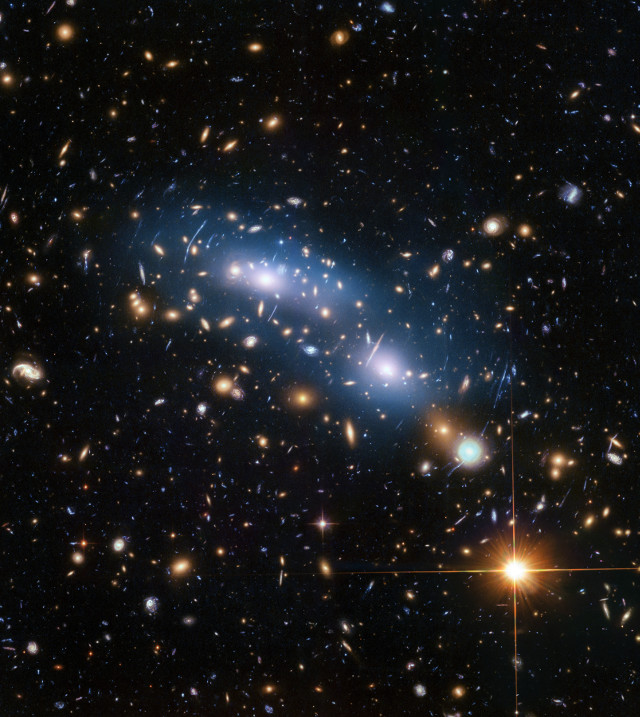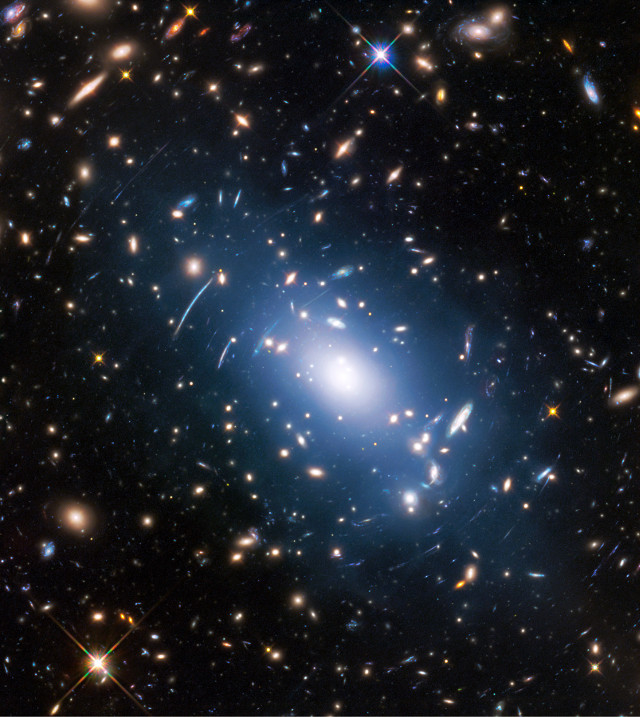
An article published in the journal “Monthly Notices of the Royal Astronomical Society” describes a new method to detect and map the dark matter existing in galaxy clusters with a higher precision than those used so far. Mireia Montes of the University of New South Wales, Australia, and Ignacio Trujillo of the Canary Islands Institute of Astronomy, Spain, exploited the so-called intracluster light, the faint light within galaxy clusters produced by their interaction, detected in the Hubble Frontier Fields program, to map the distribution of dark matter within them.
Between 2013 and 2017, the Frontier Fields program used the Hubble Space Telescope to observe galaxy clusters. These observations reached levels of detail never seen before for galaxies with light between 10 and 100 times dimmer than those observed before thanks to the possibility of exploiting their magnifying effects of gravitational lenses to watch galaxies that are farther away.
Those observations of galaxy clusters can detect their intracluster light, visible in blue in the images, generated as a consequence of the interaction between the galaxies that form them. The light is that of the stars that are torn from their galaxy because of the gravitational interactions and end up in other areas of the cluster, attracted to the regions where there’s the greatest concentration of matter and therefore where gravity is at its strongest. Dark matter is present in far greater amounts than ordinary matter since they respectively make up 85% and 15% of the matter present in the universe, so it’s the one that generates the most gravitational effects, allowing it to be mapped.
Dr. Mireia Montes explained that the stars observed in the sample of six clusters used for the test have a distribution identical to that of dark matter as far as our current technology allows to study it. In essence, stars offer a way of seeing dark matter, at least partially circumventing the main problem that astronomers have, that is the fact that it’s invisible and therefore must be mapped indirectly.
This kind of dark matter mapping is more precise than the others so far used and is also faster. For example, in the case of the Frontier Fields program’s galaxy clusters, the analysis of gravitational lens effects generated by dark matter’s gravity force takes a long time to reconstruct its distribution while the new method requires only deep field images.
Dr. Ignacio Trujillo explained that the Frontier Field program’s images showed intracluster light with unprecedented clarity and also point out the possibility to investigate into the nature of dark matter with the new mapping method. In particular, he talked about the fact that dark matter seems to interact with ordinary matter only through gravity but if it self-interacts in some way it would be possible to detect small differences in its distribution compared to the stars’ dim glow. This would be a new, follow-up type of investigation.
Mireia Montes and Ignacio Trujillo intend to extend their study to other galaxy clusters to verify the accuracy of their dark matter mapping technique. Trujillo would like to try to use it to map dark matter in single galaxies, for example by exploring their stellar halos exploiting the stars surrounding the galaxies as a result of mergers.
Intracluster light is considered a problem in the use of gravitational lenses because it interferes with the observations of the galaxies farther away but the new technique to map dark matter could turn it into an asset. Further studies of other galaxy clusters or even single galaxies could be conducted by different teams of researchers and this is important to verify their validity. If the accuracy of the results will be confirmed, it will allow to test the various models about dark matter and also the alternative ones proposed by those who believe that actually it doesn’t exist.