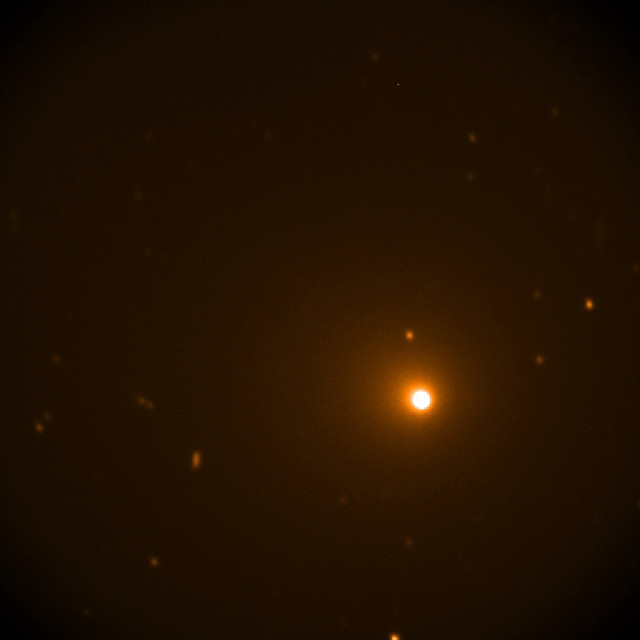
Various telescopes such as the Hubble Space Telescope, the SOFIA flying telescope and the ALMA radio telescope were used to examine the innermost region of Comet 46P/Wirtanen, nicknamed the Christmas comet because in recent days it made an Earth flyby. This expression has to be considered in a broad sense since it reached 11.6 million kilometers (more than 7 million miles) on December 16. This was enough to obtain interesting information such as the detection of hydrogen cyanide molecules in its nucleus by ALMA.
Comet 46P/Wirtanen is a short-period comet as it currently has an orbital period of only 5.44 years. Initially it was the target of ESA’s extraordinary Rosetta space probe mission, but plans changed. In 2013 there wasn’t a real Earth flyby, this year the comet’s trajectory brought it close enough to be able to study its characteristics in depth, even as a target of a future space mission.
People who regularly follow astronomical research are used to seeing the ALMA (Atacama Large Millimeter/submillimeter Array) radio telescope, inaugurated in March 2013, used to study interstellar gas clouds and objects that sometimes are billions of light years away. However, in some cases its power and sensitivity are also useful to study objects within the solar system such as Comet 46P/Wirtanen.
The ALMA radio telescope allowed to obtain a close-up image of Comet 46P/Wirtanen’s nucleus detecting the emissions of hydrogen cyanide molecules, a simple organic molecule that’s formed in the very thin atmosphere surrounding the nucleus. The top image (ALMA (ESO/NAOJ/NRAO), M. Cordiner, NASA/CUA, Derek Demeter, Emil Buehler Planetarium) shows side by side 46P/Wirtanen seen on December 2 at radio waves by ALMA on the left and at optical frequencies seen by an MN190mm astrograph telescope to which a Canon 6D camera was connected.
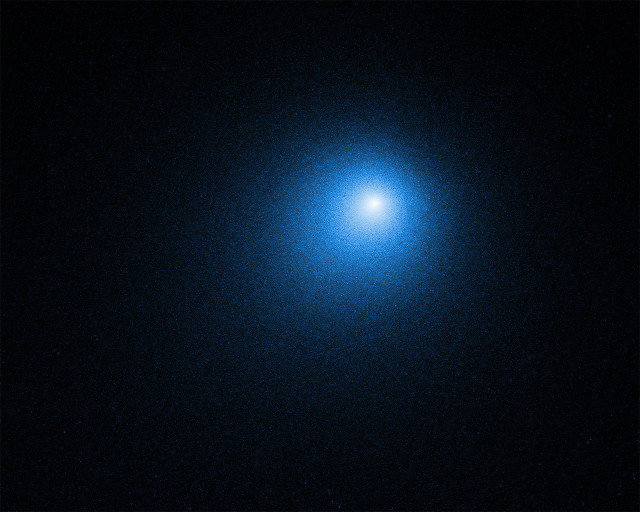
On December 13, Comet 46P/Wirtanen was observed by the Hubble Space Telescope. In the image right below at visible light, the nucleus is hidden at the center of the glow coming from the cloud of gas that forms its coma. Hubble’s Wide Field Camera 3 (WFC3) instrument took a series of photos that were later processed with the application of the blue color. They were studied together with others taken by NASA’s Chandra and Swift space telescopes to study the release of gas from the nucleus. Space telescopes can see the innermost part of the comet, which is not normally visible from the Earth.
On December 16 and 17 the SOFIA (Stratospheric Observatory for Infrared Astronomy) flying telescope studied the presence of different hydrogen isotopes in the water present in Comet 46P/Wirtanen from an altitude of over 15,000 meters (about 40,000 feet). The bottom image is at visible light and in this case an orange filter was applied to indicate the intensity of light relative to other objects. Other observations were conducted at infrareds for subsequent analysis of the water present on the comet as part of the studies of the origin of water on Earth.
Comet 46P/Wirtanen will be visible for a few weeks even to the people who are simply curious and only have a pair of binoculars or a spyglass. It represents an interesting target for amateur astronomers, who can also find information on a website dedicated to an observing campaign. The great telescopes were used to try to get details to add to our knowledge of these objects that are connected to the history of water but also of organic molecules on Earth.