
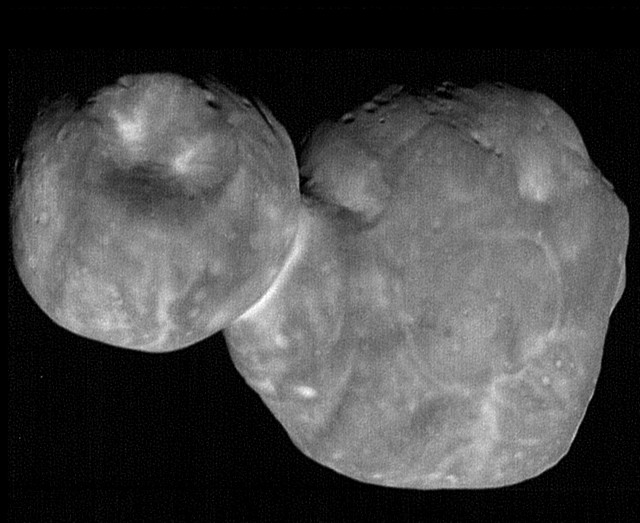
 NASA and The Johns Hopkins University Applied Physics Laboratory have published some photos of the Kuiper belt object cataloged as 2014 MU69 and nicknamed Ultima Thule taken by the New Horizons space probe’s LORRI camera only six minutes before its maximum approach. At only 6,628 kilometers (4,109 miles) from it and at its very high speed there was the risk of not being able to perfectly aim at a such a small object but the operation was successful.
It was 5.33 UTC of New Year’s Day 2019 and the New Horizons space probe was conducting its Ultima Thule flyby at a speed of about 51,500 km/h (32,000 mph) taking photos with its LORRI (Long-Range Reconnaissance Imager) camera and other detections with its other instruments on board. It was a stretched goal for the difficulties of an operation never done before, since in comparison its July 14, 2015 Pluto flyby was simple given its far greater size and brightness.
To get the best possible precision, the mission’s scientists conducted observations of Ultima Thule from the Earth using ground telescopes, space telescopes, and the SOFIA flying telescope. Observations were also made in cases of occultation, when the object passed in front of a star, and in these cases the data collected by ESA’s Gaia space probe, which is mapping the whole sky, are also useful. Despite all these data on this object’s position, there was still a certain risk that the LORRI’s aim wasn’t perfect.
At 5.26 UTC, the LORRI camera captured the newly published image (NASA/Johns Hopkins Applied Physics Laboratory/Southwest Research Institute, National Optical Astronomy Observatory), which revealed a perfect aim as it shows the whole Ultima Thule and with greater details of its surface compared to previous images. For example, several bright and more or less circular terrain features are among the mysteries of this object and so far they weren’t clearly visible. The pits near the boundary between the side illuminated by the Sun and the dark side are more detailed, a new contribution to the discussions about their nature as they could be impact craters, pits opened after the sumblimation of volatile materials or else.
Alan Stern, the principal investigator of the New Horizons mission, stressed the excellent result obtained by the space probe and the details that are now visible in an object different from all those that have been explored so far. NASA’ OSIRIS-REx missions and the Japanese space agency JAXA’s Hayabusa 2 mission are exploring as many asteroids but Ultima Thule is in the Kuiper belt about 6.6 billion kilometers (4.1 billion miles) from Earth, in an area of the solar system that we’re just starting getting to know. Every new detail that will be discovered thanks to the data that New Horizons will keep on transmitting up to 2020 of this humble asteroid will improve our knowledge of the solar system and of the processes of planetary formation.
