
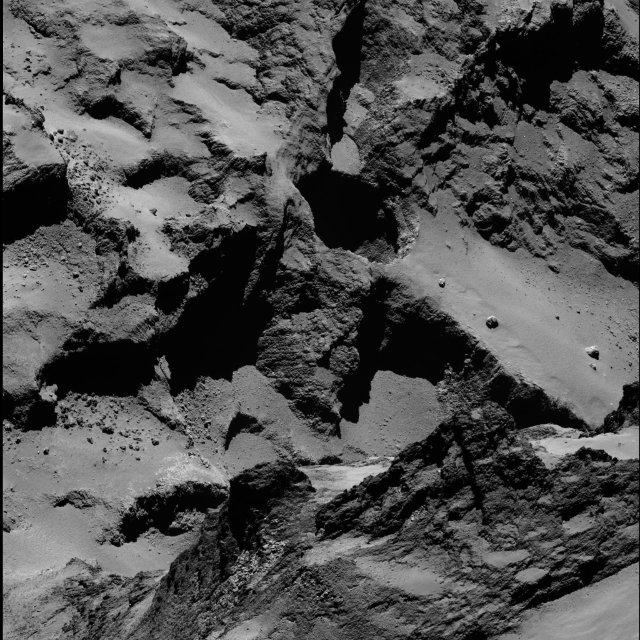
An article published in the journal “Nature” describes a research on a series of 18 pits on the comet 67P/Churyumov-Gerasimenko. They are nearly circular and some of them are a source of activity, emitting jets of gas and dust. They were discovered a long time ago but an analysis of the images collected by ESA’s space probe Rosetta’s OSIRIS camera allowed to establish that probably they were formed following a collapse of the surface.
The Rosetta space probe reached the comet 67P/Churyumov-Gerasimenko last year but it took some time to understand the nature of the strange pits found in photographs taken by its OSIRIS (Optical, Spectroscopic, and Infrared Remote Imaging System) camera. The term pit really doesn’t give an exact description of these geological features, which can have a diameter of even a few hundred meters. They actually resemble some sinkholes that can be found on Earth.
Analyzing the images, the authors of the research concluded that these pits were formed following the collapse of the roof of an underground cavity that has become too thin. The cause of the formation of the voids isn’t clear yet but the researchers suggested three possible ways.
One idea is that the voids existed since the formation of the comet 67P/Churyumov-Gerasimenko as a result of low-speed collisions between the primordial blocks that formed it. The collapse of the roof may be caused by the weakening of the surface, due to the sublimation of some material or due to other geological activity.
The second idea is that the voids were generated by the sublimation of carbon dioxide and carbon monoxide ice under the surface. The sunlight warmth could penetrate below the surface during an approach of the comet 67P/Churyumov-Gerasimenko the Sun.
The third possibility is that sublimation was caused by the energy released by the ice water that changes its physical state from amorphous to crystalline. This may generate enough heat to cause the sublimation of carbon dioxide and carbon monoxide ice.
Being able to understand the processes of formation of these pits would help to determine the makeup of the comet 67P/Churyumov-Gerasimenko and its age. The presence of the space probe Rosetta, which allows to observe the changes that occur on the surface of the comet, is crucial in this type of research. The recent extension of the mission until the end of September 2016 is a help and if ESA can achieve stable communications with the lander Philae many other data may be added.
