
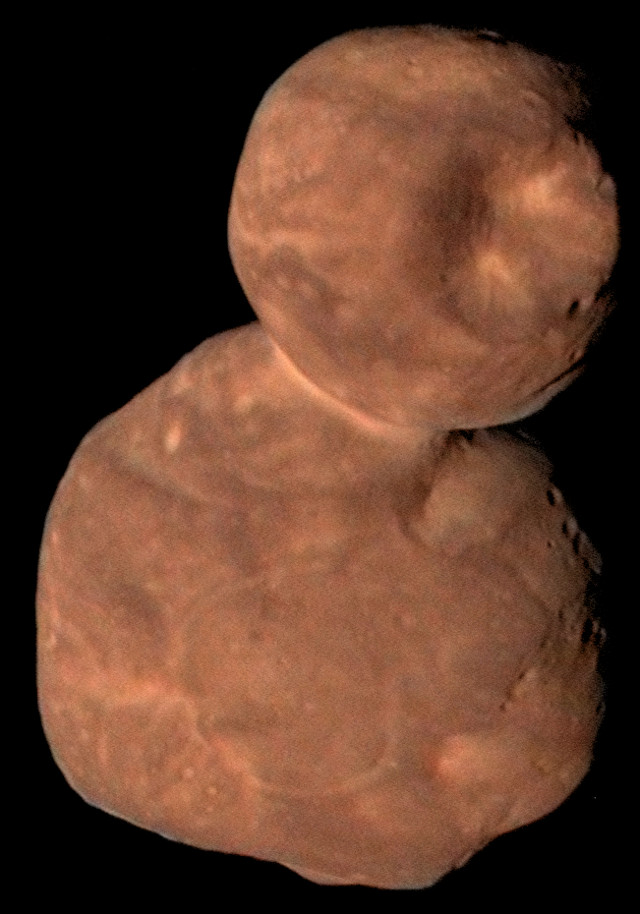
An article published in the journal “Science” reports the initial results of the exploration of the Kuiper Belt Object 2014 MU69 nicknamed Ultima Thule by NASA’s New Horizons space probe. There are no particular surprises after the ones arrived thanks to the first images sent to the Earth but the following high-resolution ones along with spectrometric data and other data sent allowed to put together some more details about its characteristics from the mission team.
The Ultima Thule’s January 1, 2019 flyby was the farthest conducted so far and allowed us to see for the first time the details of an asteroid so far away, whose orbit has a semi-major axis equal to about 44.6 times the average distance of the Earth from the Sun. It’s a member of the Kuiper Belt that belongs to the so-called cold classical population, which means an object that orbits at an average distance greater than 41 times that of the Earth from the Sun and relatively little perturbed.
Ultima Thule is a so-called bilobate object, formed by two smaller asteroids that at some point collided at low speed and merged instead of destroying each other. The scientists think that the two asteroids became tidally locked before colliding. Such objects are not uncommon but the surprise came from the fact that the two lobes don’t have a vaguely spherical shape, so much so that they were compared to a walnut and a hamburger.
The lobe nicknamed Ultima has an estimated size of about 22 x 20 x 7 kilometers with an uncertainty of less than 0.6 × 1 × 2 kilometers and the one nicknamed Thule has an estimated size of about 14 × 14 × 10 kilometers with an uncertainty less than 0.4 × 0.7 × 3 kilometers. In essence, especially the largest lobe nicknamed Ultima is flattened and has a truly surprising lenticular shape. There’s no explanation for that shape, just some hypotheses that range from the growth from a cloud of pebbles that was already flattened to the frontal collision of two very similar sized objects with a really narrow speed range to the deformation caused by rapid spinning or tidal forces suffered before merging with Thule.
Despite its enormous distance from the Sun, even Ultima Thule has its seasons with notable changes in insolation due to an an axial tilt, or obliquity, of 98°. The consequence is that its polar days and nights last whole decades. The estimates of summer surface temperatures are around 60 Kelvin while winter temperatures are estimated at between 20 and 35 Kelvin.
Even the variety of features on Ultima Thule’s surface is the subject of much interest by scientists to understand the processes that can occur billions of kilometers from the Sun. The relatively large depression with its diameter of about 7 kilometers on the Thule lobe was nicknamed Maryland and probably is the consequence of an impact but other wells may have been created by other types of processes.
The more than 200 authors of the article from over 40 institutions led by Alan Stern will continue their studies of Ultima Thule by analyzing the data that the New Horizons space probe will send until the summer of 2020. Any information could be crucial to reveal any secrets of this fossil left over from the first phase of the solar system’s formation.
