
An article published in the journal “Nature Astronomy” reports the observation of a huge coronal mass ejection (CME), a huge stellar eruption in which an enormous amount of materials is thrown out, by the star HR 9024. A team of researchers led by Constance Argiroffi of the University of Palermo and associated of the National Institute of Astrophysics used data collected by NASA’s Chandra X-ray Observatory to find traces of the ejection of a mass about 10,000 times greater than that of the most powerful events of that kind generated by the Sun.
About 450 light years away from Earth, the star HR 9024, also known as OU Andromedae and with other acronyms depending on the catalog, is a yellow giant, a phase that occurs at the end of the evolution of a not very massive star, in this case with a mass almost three times the Sun’s. HR 9024 was already the subject of interest by various astronomers because it’s a variable star with some anomalous characteristics such as a very high spin rate for a star in that evolution phase.
Among the telescopes used to observe HR 9024 there’s NASA’s Chandra X-ray Observatory and its HETGS (High Energy Transmission Grating) instrument recorded a really huge coronal mass ejection given that the ejected mass was estimated in about 10,000 times that of the most powerful flares generated by the Sun. In this case the plasma was observed as it went up and down at speeds between 100 and 400 km/s and it had temperatures estimated between 10 and 25 million degrees Kelvin.
This is an unprecedented result in the observation of a coronal mass ejection from a star other than the Sun. The observations match theoretical models and Costanza Argiroffi stressed the fact that this was not obvious since our understanding of flares is based almost completely on solar observations.
After the flares observed on the star HR 9024, the researchers found cold plasma – where the term indicates a temperature still around 4 million degrees Kelvin – which rose from the star at a speed of about 300,000 km/h. Again the data matched the predictions made using the theoretical models.
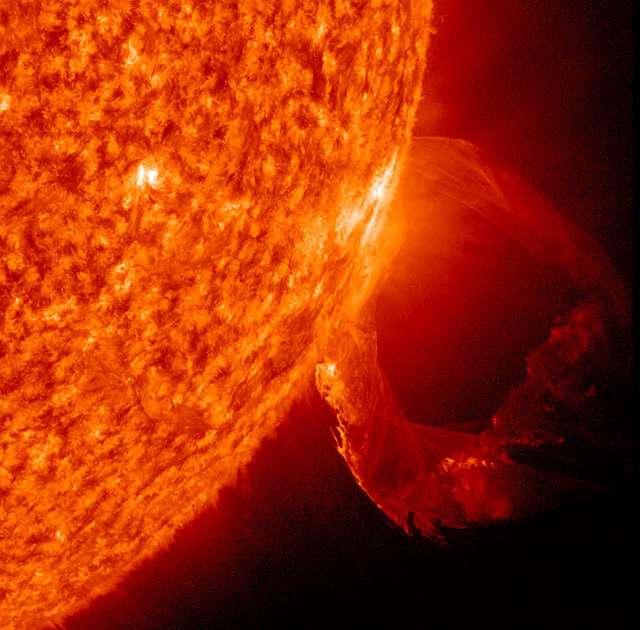
The data collected by Chandra also allowed to estimate the mass ajected by the star HR 9024 around one quadrillion tons. That’s in line with the theory that these phenomena in active stars like the one studied are larger scale versions of the solar ones of the type shown in the image.
A piece of data that doesn’t match predictions is the speed at which the ejected materials moved, which is lower than expected. According to the researchers, the magnetic field in active stars is probably less efficient in accelerating coronal mass ejections.
This research shows the possibility of studying the activity of stars other than the Sun to examine important events. The study of coronal mass ejections by stars other than the Sun is a very recent thing and will allow to better understand the processes taking place in stars, useful for better understanding the Sun as well.
