
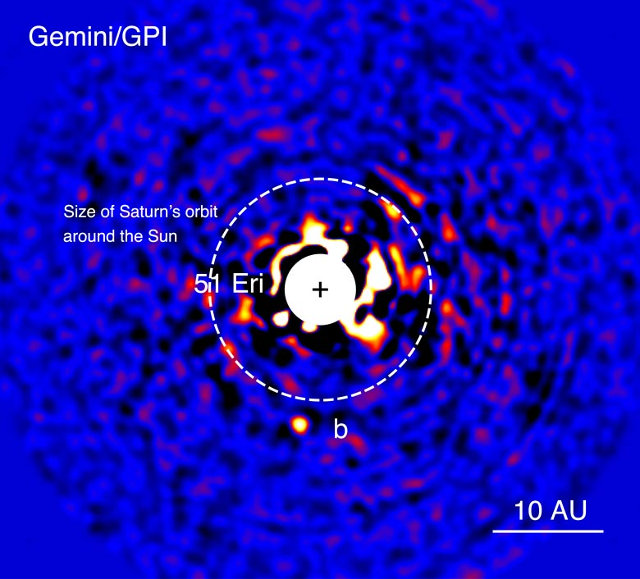
Planet 51 Eridani b is the first discovered using the Gemini Planet Imager (GPI), an instrument that started operating at the beginning of 2014 with the express purpose of directly detecting planets outside the solar system. This is the smallest exoplanet observed directly so far and its characteristics suggest that resembles Jupiter when it was very young. The results of this research were published in the journal “Science”.
The star 51 Eridani, that is nearly 100 light years from Earth, is well known because it’s visible to the unaided eye. It’s interesting as an object of study because it’s very young, with an estimated age of 20 million years. GPI is just the right instrument to look for planets orbiting a star at that distance.
The advantage in this case is that young planets emit a lot of energy following the fall of materials on them, resulting in heating, during their formation. This energy gets released for many millions of years but despite these emissions only the GPI managed to identify 51 Eridani b.
Other planets observed directly through GPI have a mass much greater than that of Jupiter, that of 51 Eridani b is “only” twice it, making it the smallest exoplanet photographed so far. It’s also the coldest so far observed directly but the term is to be meant in the very relative sense as we’re talking about 430° Celsius (about 800° Fahrenheit), enough to melt lead.
The distance of the planet 51 Eridani b from its star is slightly higher than that of Saturn from the Sun. Despite its heat, the light it emits is three million times fainter that that of its star and that’s the reason why other instruments failed to identify this exoplanet. GPI is designed especially for this purpose so it was able to photograph it.
These characteristics of 51 Eridani b make it only vaguely similar to Jupiter with a matching in the fact that it’s a gas giant. The really interesting element emerged from the analysis of the infrared emissions of this exoplanet is the amount of methane in its atmosphere.
Previously, other gas giants showed only faint traces of methane while carbon was found in abundance in the form of carbon monoxide. This made these giant planets very different from those in the solar system, which contain a lot of methane instead. The atmosphere of 51 Eridani b is rich in methane and it’s this feature that makes it similar to Jupiter.
The 51 Eridani system is an opportunity to study the mechanisms of planetary formation of gas giants. Other Jovian exoplanets are significantly hotter than models predicted, suggesting that they formed much more quickly. 51 Eridani b seems to have formed according to models, like Jupiter. Examining other young solar systems, also with GPI, will allow to better understand these mechanisms.

