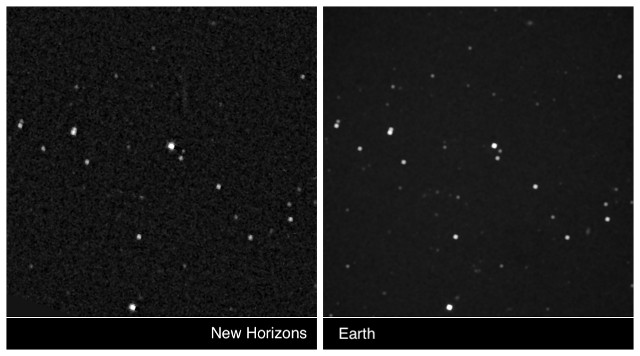
NASA has released images obtained by its New Horizons space probe during the interstellar parallax experiment conducted on April 22 / 23, 2020. The LORRI camera was aimed at Proxima Centauri and Wolf 359, two of the stars closest to the system solar, obtaining images that show how they appear in different positions from the ones we see from Earth. It’s an application of the parallax phenomenon with the apparent movement of the two stars caused by the fact that New Horizons is about 7 billion kilometers from Earth. The combination of images captured by New Horizons and an instrument on Earth shows the parallax effect, which in the future could help interstellar navigation instruments like sailors have been using the positions of stars to navigate the seas of Earth.
After flying by the farthest object, the asteroid already known as Ultima Thule and now by its name of Arrokoth, on January 1, 2019, the New Horizons space probe continues to be fully operational and have power to work until the next decade. NASA is also evaluating the possibilities for a third flyby after the Pluto and Arrokoth’s in fuction to the fuel available to set a new route.
Pending a decision on a new mission, New Horizons is conducting other surveys, often of the electromagnetic emissions and particles present in that area. In this case it detected the position of the two stars Proxima Centauri and Wolf 359 in the first interstellar parallax experiment becoming the first spacecraft to send images of the sky from a point so far from Earth that the two stars photographed are in different positions from the ones we see from Earth.
The top image (NASA/Johns Hopkins Applied Physics Laboratory/Southwest Research Institute/Las Cumbres Observatory/Siding Spring Observatory) shows Proxima Centauri seen from Earth and the New Horizons space probe. The bottom image (NASA/Johns Hopkins Applied Physics Laboratory/Southwest Research Institute/University of Louisville/Harvard and Smithsonian Center for Astrophysics/Mt. Lemmon Observatory) shows Wolf 359 seen from Earth and the New Horizons space probe. In both cases, to have a stereoscopic vision, you have to cross your eyes until the two views merge into one. The image below (Pete Marenfeld, NSF’s National Optical-Infrared Astronomy Research Laboratory) illustrates the stellar parallax phenomenon applied to views from Earth and New Horizons.

Alan Stern, the New Horizons mission principal investigator, stated that it makes sense to say that New Horizons is looking at an alien sky, different from what we see from Earth. No human eye can see the shift of the stars due to the movement of the Earth because even the revolution of the Earth around the Sun generates too small a parallax, which can only be measured by precision instruments.
At a distance of about 7 billion kilometers from Earth, the parallax becomes significant for nearby stars. Today, it’s an experiment that expands the ones made in the past, when New Horizons was used to create stereoscopic images of Pluto and Arrokoth. In the future, this phenomenon could help interstellar navigation instruments. New Horizons continues to move away from Earth, so the parallax baseline continues to increase, as a consequence more stars will appear in different positions from those we see from Earth.