
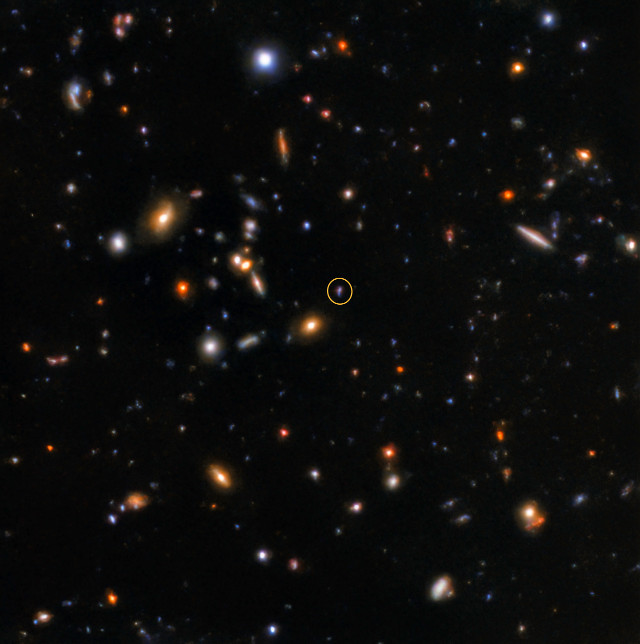
An article to be published in “The Astrophysical Journal Letters” reports a study of the short gamma-ray burst cataloged as GRB181123B focusing on the discovery of what in jargon is called afterglow, in short, the residues of the emissions of GRB181123B, which in this case were detected at optical frequencies as well. The estimates indicate that that event was generated around ten billion years ago making it the most distant ever detected with an optical afterglow. Probably the cause was a neutron star merger, so events of this type offer information on how long it took for them to occur and their amount at that time.
In recent years, the detection of many new gamma-ray bursts is allowing us to understand their origin much better. The very different durations are now interpreted with some certainty about different causes. This research concerns a short gamma-ray burst detected on November 18, 2018 by NASA’s Swift space telescope.
Cataloged as GRB181123B, this gamma-ray burst had a peak that lasted around 0.4 seconds, but its afterglow lasted for a few hours. It’s a short time, but the alert sent to astronomers around the world allowed, for example, the remote use of the Gemini North telescope in Hawaii and in particular the Gemini Multi-Object Spectrograph (GMOS) instrument. This is how astronomers intervened in time to observe the afterglow discovering its emissions at optical frequencies.
Other telescopes were also aimed in time towards the area of the event GRB181123B allowing to obtain more information such as the spectrographic ones from the Gemini Sud. This allowed to identify the galaxy in which probably two neutron stars merged in what in jargon is called kilonova. The universe was about 3.8 billion years old, a period in which there was a lot of activity in many galaxies with a lot of massive stars that formed, furiously consumed their hydrogen, and after a few million years exploded in supernovae leaving behind neutron stars and black holes.
To study these phenomena in detail, it’s necessary to observe other similar gamma-ray bursts. The problem is that only in certain cases a telescope can stop its normal activity and be aimed at the area where a short gamma-ray burst has just been detected for follow-up observations of its afterglow.
Only a minority of the known short gamma-ray bursts have distances comparable to that of GRB181123B. Kerry Paterson, lead author of this study, stated that she and her colleagues think that this event is the tip of the iceberg concerning distant gamma-ray bursts. Astronomers are improving alert systems, so in the future we can expect to get more information on these extremely energetic events.
