
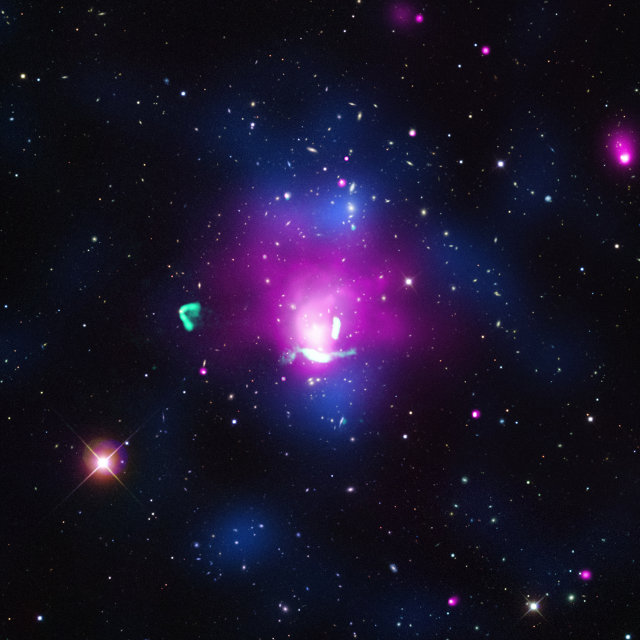
An article in the journal “Monthly Notices of the Royal Astronomical Society” describes a research on the galactic cluster Abell 1033. Combining data from NASA’s Chandra X-ray Observatory, the Westerbork Synthesis Radio Telescope in the Netherlands, NSF’s Karl Jansky Very Large Array (VLA), and the Sloan Digital Sky Survey (SDSS), a team of astronomers reconstructed the history of a cloud of electrons at the cluster’s center. It was reignited after a cosmic collision and for this reason it’s been compared to the legendary phoenix.
The cluster Abell 1033 contains over 350 galaxies and is located about 1.6 billion light years from Earth. Within clusters of this kind it’s normal that collisions between galaxies occur and among the consequences there’s the heating of gas clouds contained in them, invested by shock waves. The ionized gas that moves rapidly radiates a significant amount of radio waves.
The astronomers think that the supermassive black hole at the center of Abell 1033 erupted in the past. Beams of high-energy electrons filled regions of the diameter of hundreds of thousands of light years and produced a cloud of bright radio emissions. This cloud faded away over millions of years when electrons lost their energy and the cloud expanded.
A “radio phoenix” is a possible type of radio source coming from a galaxy cluster. It manifests when the initial effects of a collision fade away and the gas gets cooled down, causing the fading of radio emissions. A subsequent merger of nearby galaxies can produce a strong shock wave and if it passes through the “fossil” material it can compress it giving it new energy.
That’s what astronomers think happened in Abell 1033 when another galaxy cluster collided with the original one. That created shock waves that provided new energy to an electron cloud that was dead. At that point, the cloud started shining at radio frequencies.
By combining data from observations of Abell 1033 made with different instruments at multiple wavelengths it was possible to obtain a more complete picture of this radio phoenix. The pink color was used to represent the X-rays captured by Chandra, green to represent radio waves captured by the VLA. They were put over the background image at optical frequencies from the SDSS. A map of galaxy density created by the analysis of optical data is in blue.
The astronomers think they identified the radio phoenix shortly after its birth because its intensity decreases very rapidly when it’s close to the center of the cluster, exactly as the one in Abell 1033. We’re talking in astronomical terms, which means that this phenomenon could last “only” a few tens of millions of years.
