
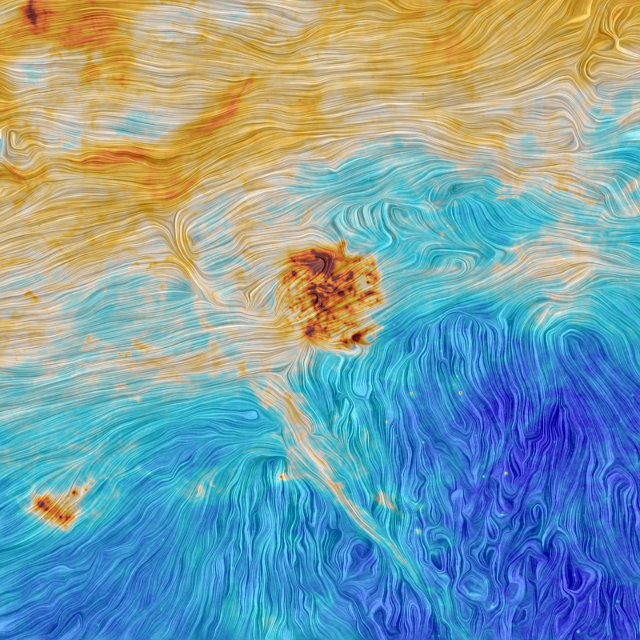
ESA has released an image created using data from the Planck Surveyor satellite offering a very special portrait of an interstellar filament and the Magellanic Clouds. Those are two dwarf galaxies that are part of the Milky Way’s neighborhood and Planck detected the dust between the stars within them during its mission. The main purpose of this satellite was to study the cosmic microwave background radiation (CMB or CMBR), but the data collected are also useful to map the galaxies’ dust and magnetic fields.
In the image, the Large Magellanic Cloud, about 160,000 light-years away from Earth, is made up of a kind of a red and orange blob near its center. The Small Magellanic Cloud, about 200,000 light ani from Earth, is made up of the more or less triangular shape in the bottom left. These two galaxies are much smaller than the Milky Way.
In December 2014, ESA published an image created using data from the Planck Surveyor showing the interaction between the interstellar dust in our galaxy and the structure of the galactic magnetic field. In this new image, a part of that representation can be seen in the upper part, which belongs to an area corresponding to the constellation of Chamaeleon, in the southern hemisphere sky.
In addition to the galaxies, in this image you can see an interstellar filament. It starts from the dense clouds of gas and dust in the constellation of Chamaeleon and extends towards the opposite corner. It appears between the two Magellanic Clouds but is actually relatively close to us, only 300 light years away.
This type of analysis is useful for scientists to study the structures of the magnetic fields and the distribution of interstellar gas. The alignment of the filaments may be different with respect to the direction of the magnetic field: for example, in the dense clouds in which the stars are formed, the filaments tend to be perpendicular to the interstellar magnetic field.
These studies are allowing us to understand the role of the galactic magnetic field in the build-up of structure within the Milky Way that lead to star formation. From a visual standpoint, the result is the creation of extraordinary images that look like Vincent Van Gogh’s paintings.
[ad name=”eBayUSUKAstronomy”]
