The mysteries of the dwarf planet Ceres are a topic of discussion at the European Planetary Science Congress going on these days in Nantes, France. For the occasion, NASA published new topographic maps of Ceres based on data collected by its Dawn space probe, which has been mapping it for a few weeks. The latest news on this dwarf planet came from some emission of energetic electrons.
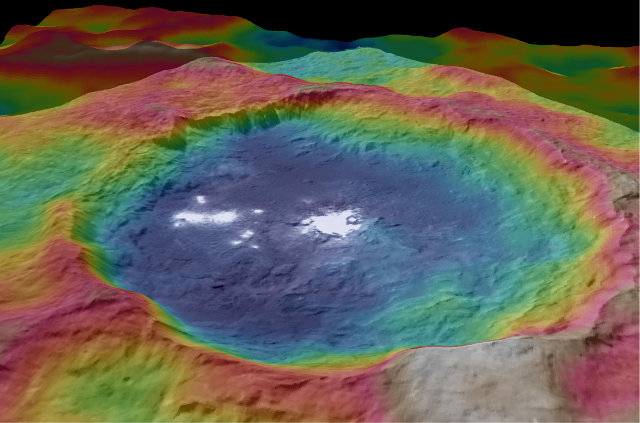
Images taken using infrared (920 nanometers), red (750 nanometers) and blue (440 nanometers) spectral filters were combined to create these color topographic maps of the dwarf planet Ceres. Those are false colors used to highlight the various topographic features of the surface.
This technique allows scientists to better understand the different features of Ceres’ surface. The various colors show the different ways light is reflected in different areas and it helps to understand the mineral composition of a certain area of the surface and also the age of the various topographical features.
Occator crater is one of the areas that keeps on rising the greatest interest for the presence of the mysterious white spots. In the image of that area, the width of about 90 km (about 56 miles), the area with the lowest altitude is colored blue while the one with the highest altitude is colored brown. The investigation into the origin of the white spots continues.
The craters of Ceres show irregular shapes, similar to those of the craters found on Rhea, one of Saturn’s moons. Those shapes are very different from those of the giant asteroid Vesta’s craters, studied by the Dawn space probe in recent years. Vesta’s are in fact bowl-shaped. Since these are the two largest celestial bodies in the asteroid belt between Mars and Jupiter all the differences between them can be very interesting from the scientific point of view.
Another surprise came from the Dawn space probe’s GRaND (Gamma Ray and Neutron Detector) instrument. With its 21 sensors it’s usually used to measure the abundance of various elements in Ceres’ rocks. However, recently it detected bursts of energetic electrons. The hypothesis is that they are the result of an interaction between Ceres and solar radiation but that’s another phenomenon that is under investigation to understand it.
Currently, the Dawn space probe is mapping Ceres from an altitude of 1,470 km (915 miles). In the course of October it will begin the last phase of its mission going down again until reaching an altitude of only 375 kilometers (230 miles). The new mapping will be even more precise. The mission will then continue at least until mid-2016.