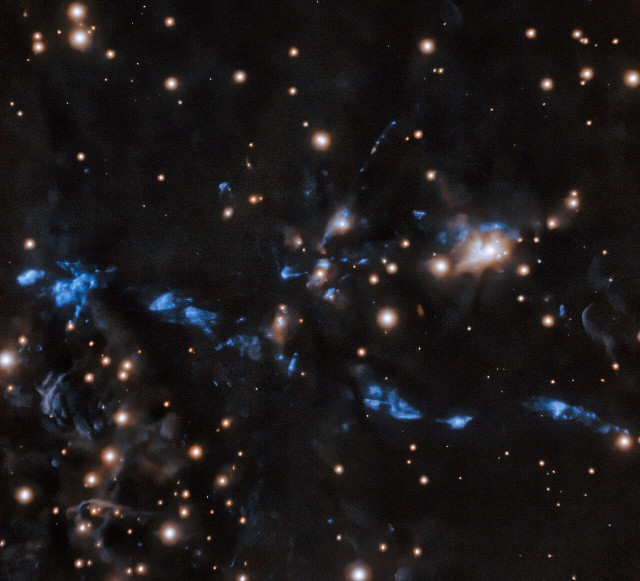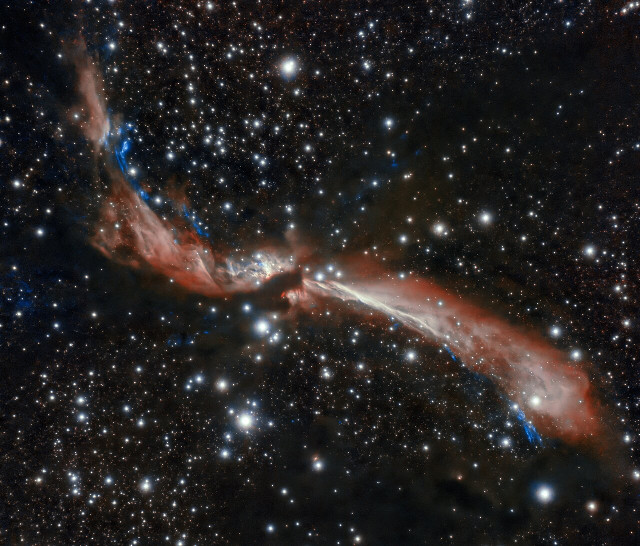
An article published in the journal “Astronomy and Astrophysics” reports observations of stellar jets cataloged as MHO 2147 and MHO 1502 emitted by two protostellar sources. A team of researchers used the Gemini South telescope in Chile to study those jets, which have an appearance that is likely influenced by the gravitational pull of companion stars. The quality of the observations is due to the adaptive optics system designed to compensate for the distortion caused by the Earth’s atmosphere.
According to current star formation models, the interaction between a protostar’s magnetic fields and the gas disk surrounding it causes the emission of two twin jets of ionized gas in opposite directions. Observations of this type of jet help to verify and improve these models, therefore the protostars and their jets are studied with any instrument capable of offering an adequate quality.
Ground-based telescopes have among their problems the distortion that can be caused by the Earth’s atmosphere. To compensate for this, adaptive optics systems have been developed. The Gemini South telescope is equipped with a system of this type called the GeMS (Gemini Multi-conjugate Adaptive Optics System) with which astronomers can use the near-infrared camera GSAOI (Gemini South Adaptive Optics Image). This system made it possible to study the jets of two protostars thanks to the exceptional quality of the images captured.
The protostar cataloged IRAS 17527-2439 is about 10,000 light-years from Earth and emits the double jet cataloged as MHO 2147. It has a curved shape, compared to that of a snake, due to the fact that the jet has changed direction over time. The researchers believe there’s also the gravitational influence of nearby stars. This could be a triple system.
About 20,000 light-years from Earth, the MHO 1502 jet is very different because it’s inside a very different environment, a star-forming area of the type known as an H II region. The bipolar jet is composed of a series of knots that suggest that the source may be double with two protostars emitting materials intermittently.
The Gemini South telescope offered new information on these stellar jets but more observations will be needed to understand if MHO 2147 is really within a triple system and if the source of MHO 1502 is indeed a double system. Other instruments that can detect emissions in other bands of the electromagnetic spectrum could be used to get that kind of result because the combination of different instruments has become increasingly important to get more complete information. In this case, it’s information about star formation processes.