An article accepted for publication in “The Astrophysical Journal” reports a study on the binary system cataloged as SVS 13, consisting of two protostars surrounded by disks of materials that could lead to the formation of planets. A team of researchers used thirty years of observations conducted with the VLA and new observations conducted with the ALMA radio telescope to obtain a detailed picture of the situation. The conclusion is that each of the two protostars has its own circumstellar disk and that there’s a third disk of the circumbinary type that orbits both stars. The analysis of the data also led to the identification of nearly thirty molecules in the SVS 13 system including thirteen complex organic molecules precursors of life.
About 980 light-years away from Earth, in the Perseus molecular cloud, the SVS 13 system has been the focus of several studies over the years and often also the focus of discussions about its age. Some studies concluded that it’s in an embryonic stage while others placed it at a later stage of its evolution. It was also part of the group of systems composed of multiple protostars studied in the VANDAM (VLA/ALMA Nascent Disk And Multiplicity) survey with VLA (Very Large Array) and ALMA (Atacama Large Millimeter/Submillimeter Array). The results were presented in another article published in January 2022 in “The Astrophysical Journal”.
Specific studies on binary systems increased to try to understand how planets within them are born and develop. Models of planetary system development have been produced and refined for a long time with regard to single stars but binary systems already represent a higher order of complexity. For years, astronomers debated the possibilities that binary systems might have planets and confirmations are coming because, of the thousands of exoplanets discovered, there are several in binary systems. The VANDAM survey and specific studies such as the one on the SVS 13 system are offering some answers.
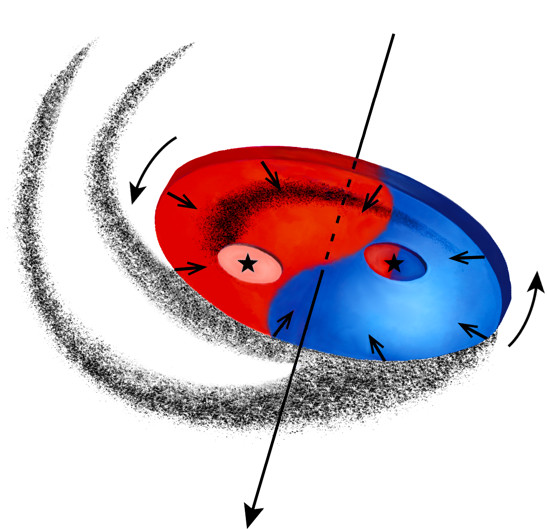
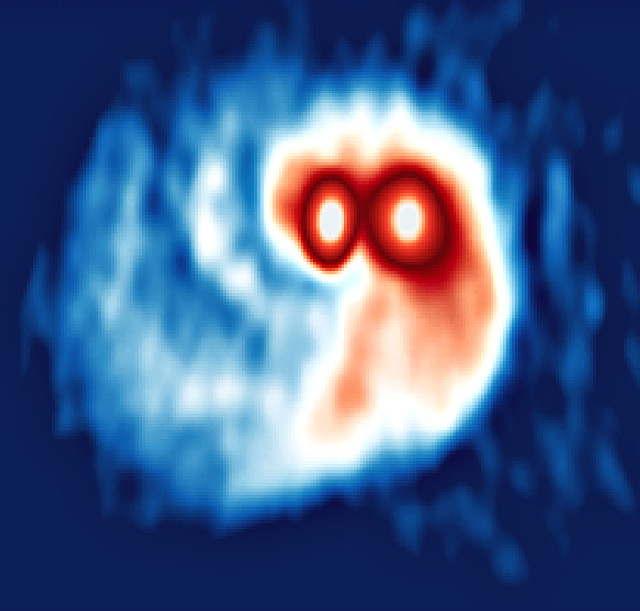
The analysis of thirty years of data collected using the VLA and data recently collected using ALMA (Top image courtesy Ana Karla Díaz-Rodríguez and Guillem Anglada) allowed to obtain the most detailed reconstruction of the SVS 13 system. This means that it was possible to reconstruct the orbits of the two protostars and the geometry of the system, to estimate the masses of the protostars and the disks that surround them, and to obtain measurements of the temperatures in the disks.
The results of the analyzes indicate that the two protostars have a combined mass close to the Sun’s and the distance between them is about ninety times that between the Earth and the Sun. They are both very young and the disks surrounding them are also in an embryonic phase and in an unusual configuration. In fact, the reconstruction of the geometry of the SVS 13 system indicates that each of the protostars has its own circumstellar disk and there’s also a third disk of the circumbinary type that orbits around both protostars. This circumbinary disk has a structure that feeds materials into the other two disks and it’s possible for planets to form in all disks.
The bottom image (Courtesy Diaz-Rodriguez et al) shows a diagram of the geometric and kinematic configuration of the SVS 13 system. The red and blue colors indicate the motion of the gas moving away from us (red) or moving towards us (blue).
Another result of the analysis of the data about the SVS 13 system concerns the molecules existing in the disks. 29 molecules have been identified which include 13 complex organic molecules among which 7 detected for the first time in this system. In essence, there are 13 building blocks of life that could “seed” future planets.
This reconstruction of the SVS 13 system was possible thanks to the many observations conducted over three decades using the VLA radio telescope array together with recent observations conducted with the ALMA radio telescope, two instruments that are crucial for radio astronomy. The amount of gas and dust present in a system still in the process of formation blocks electromagnetic emissions in many frequencies, so radio observations are indispensable in its study. This result will stimulate further studies to reveal all the secrets of SVS 13 and improve the formation and evolution models of binary and multiple systems.