NASA’s New Horizons mission team is presenting the latest findings on the dwarf planet Pluto at the 47th Annual Meeting of the American Astronomical Society’s Division for Planetary Sciences in National Harbor, Maryland. The data collected by the spacecraft during its July 14, 2015 flyby made it possible to identify possible cryovolcanoes. Data on small moons of Pluto are limited but suggest more and more that at least Cerberus and Hydra are the result of the merger of two or more asteroids.
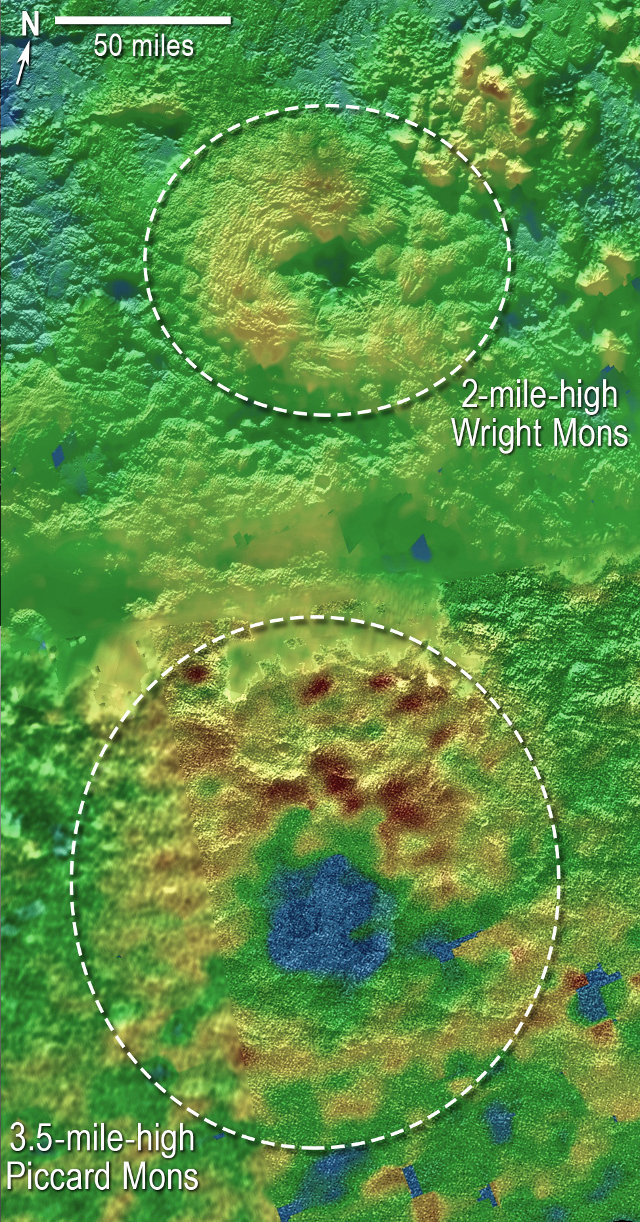
The diversity that exists on Pluto’s surface and the traces of geological activity, perhaps still in place, on the dwarf planet, are among the biggest surprises that scientists had after the New Horizons space probe’s flyby. The mission geologists combined the images arrived so far to create three-dimensional maps. They indicate that two of the largest mountains could be cryovolcanoes.
Wright Mons is a little more than 3 kilometers (about 2 miles) high while Piccard Mons is about 5 kilometers (3.5 miles) high. Both have a big hole in the middle, a typical appearance of a volcano. To be precise, they could be cryovolcanoes and that would mean that instead of lava they “erupt” ice water, nitrogen, ammonia or methane.
The presence of ammonia could be critical for the existence of these cryovolcanoes because it decreases the viscosity of the water ice 100,000 times. This would greatly help this and other types of geological activity. There are several clues but they need to study these mountains more using images and other data that will be sent in the future by the New Horizons spacecraft to prove their nature.
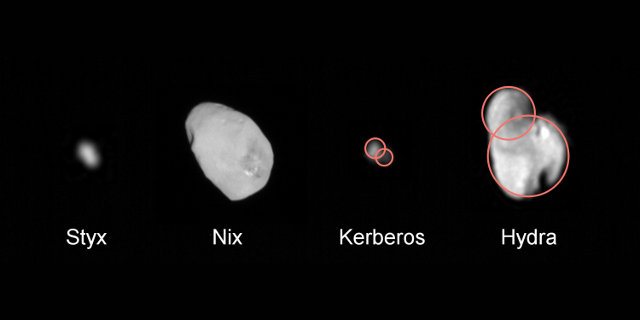
There are far more limited data on Pluto’s small moons: Styx, Nix, Cerberus and Hydra. The New Horizons spacecraft sent several pictures but only Nix was in a favorable position that allowed a good definition. Despite this, it’s possible to understand something of the other moons’ shape and the fact that they behave like spinning tops suggests a complex origin.
Already in October, a study about Cerberus included the hypothesis that it was the result of the low speed collision between two asteroids. Now the analysis of the images of the other small moons makes the scientists think that at least Hydra was formed in a similar manner. Maybe Styx and Nix also have the same origin but currently it’s not possible to determine it.
The New Horizons spacecraft completed in recent days the maneuvers needed to get en route for its next target, the Kuiper Belt planetoid called 2014 MU69, which should be reached at the beginning of 2019. In the meantime, it keeps on sending data from its flyby so our knowledge of Pluto and its moons will keep on improving.