
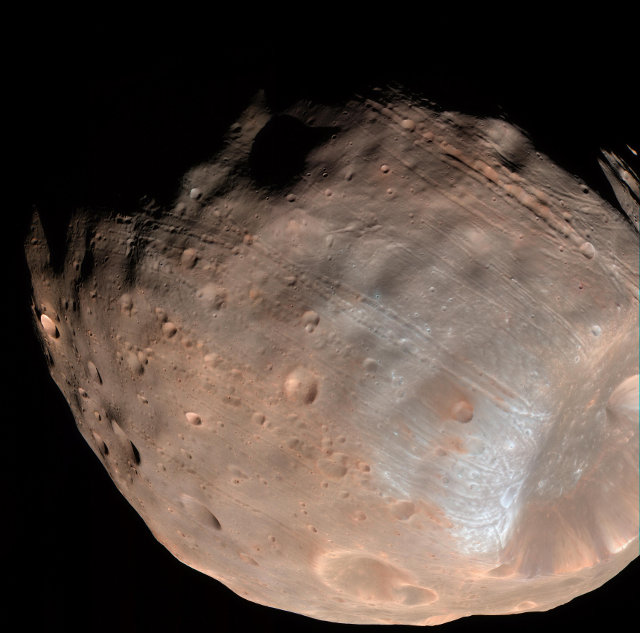
At the 47th Annual Meeting of the American Astronomical Society’s Division for Planetary Sciences in National Harbor, Maryland, A research was presented about Phobos, a moon of Mars. Terry Hurford of NASA’s Goddard Space Flight Center led a team of scientists who analyzed the grooves on Phobos surface. The conclusion is that these are the first signs of structural failure that will lead to the destruction of this moon.
Phobos is one of the two moons of Mars, discovered on August 18, 1877 by astronomer Asaph Hall, a few days after he discovered Deimos, the other moon of the red planet. These two objects are too small to have a spherical shape and it’s possible that they formed in the asteroid belt between Mars and Jupiter and were subsequently captured by the planet.
Phobos surface is crossed by many grooves and their origin has been the subject of much discussion. According to one theory they were originated by the impact of an asteroid, the same that formed the crater named Stickney. The impact almost destroyed Phobos but further analysis led to discard this theory.
The team led by Terry Hurford analyzed available data and concluded that the grooves on Phobos are the signs of gravitational tides caused by Mars. It’s not a new theory and it seemed that the gravity of the Red Planet isn’t enough to cause such effects. However today this possibility is supported by the knowledge accumulated over the past decades.
In particular, in 2008 ESA’s Mars Express space probe made a series of Phobos flybys collecting surprising data. They made it possible among other things to measure in a much more precise way than before this moon’s mass and volume. Now these data make scientists think that Phobos is made of rubble held together by an outer layer of regolith, meaning various dusty and granulous materials, up to 100 meters (about 330 feet) thick.
That kind of structure isn’t very solid and that means that Mars gravity is enough to distort Phobos shape. The outer layer can be elastic and accumulate stress with the result that grooves are created on its surface. Stress fractures generated in the model predicted by the researchers are consistent with those observed on Phobos.
The average distance of Phobos from Mars is only 6,000 kilometers (about 3,700 miles) and makes it the closest moon to its parent planet in the solar system. It gets closer to the red planet about 2 meters (6’6″) per century and for this reason scientists have predicted for some time that it will fall down between 30 and 50 million years.
However, if the findings of this new research get confirmed, Phobos structure is too weak to last that long. This moon is already beginning to show signs of failure and the situation will get worse, though very slowly. Phobos could be destroyed long before it gets close to Mars surface.
[ad name=”AmazonScience”]

Permalink