
An article published in the journal “Astronomy & Astrophysics” reports a study on the massive protostar cataloged as IRAS20126+4104 which obtained the measurement of the speed of the jets of materials that are ejected at about 100 km/h. A team of researchers led by Fabrizio Massi of the Italian National Institute of Astrophysics in Arcetri used the SOUL instrument installed on the Large Binocular Telescope (LBT) to obtain the details necessary to measure the displacements that occurred with respect to archive images dating back to 2003 and 2012. This result helps to better understand the formation processes of massive stars.
According to current models, medium and small stars have a formation process that includes a phase in which the gas from which they are born settles on a circumstellar disk causing it to slow down over time and is attracted by the protostar contributing to its growth. In this phase, collimated jets of matter perpendicular to the circumstellar disk are present and according to astronomers, there’s an important link between them. For massive stars, it’s difficult to understand if this model is valid, also because they tend to be born in large clouds full of dust that block many electromagnetic frequencies and in multiple groups, making it difficult to understand the processes connected to a specific star.
The protostar IRAS20126+4104 has an estimated mass around 12 times the Sun’s, is isolated compared to the average of that type of protostar, and is close enough to allow quality observations. For these reasons, it was already studied in the past by a team with several members in common with the one who conducted this new study. In 2012, the LBT was already used and then the PISCES camera was used by exploiting the FLAO (First Light Adaptive Optics) first generation of adaptive optics. Those results were published in January 2013 in “Astronomy & Astrophysics”.
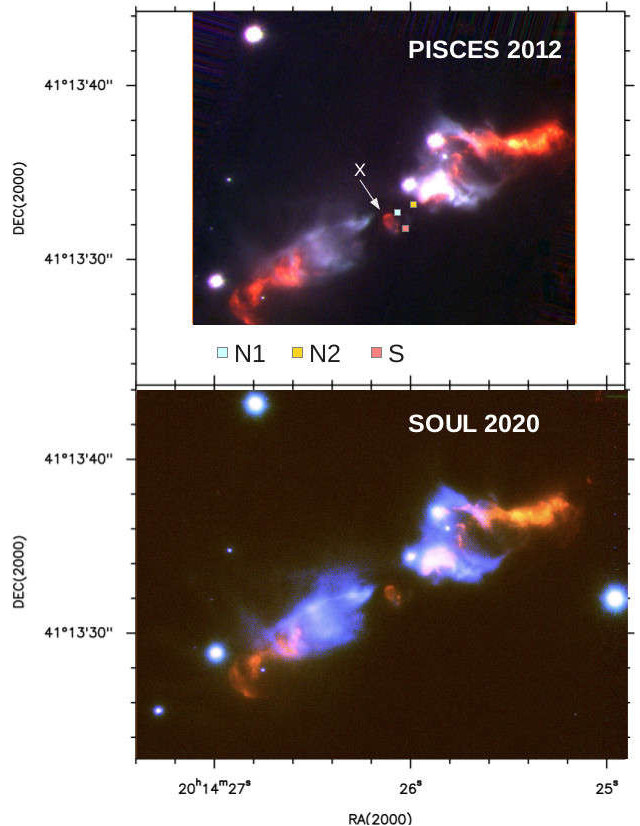
The image (Cortesia Massi et al. 2023/PISCES/SOUL/LBT) shows photos of the protostar IRAS20126+4104 and its material jets taken in 2012 and 2020 using the FLAO/PISCES and SOUL/LUCI1 instruments. The actual protostar is in the central area, indicated with an arrow in the photo captured in 2012. N1, N2, and S indicate radio sources in the area.
Now the protostar IRAS20126+4104 has been found suitable for observations with the SOUL instrument, the second generation of adaptive optics, the type designed to compensate for distortions caused by the atmosphere, at the LBT. Actually, the dust obscures IRAS20126+4104, in the center of the images, and its circumstellar disk but it’s possible to observe the collimated jets that come from it. An additional benefit is the existence of high-resolution images from observations conducted in 2003 with the Coronagraphic Imager with Adaptive Optics (CIAO) on the Subaru telescope. The different adaptive optics systems made it possible to detect the movements of materials at a speed of around 100 km/h.
The study indicates that the formation mechanisms are the same as for medium and small stars at least in the phase with a circumstellar disk and collimated jets. The analysis of its proper motions indicates that there were several episodes of ejection of matter between two hundred and four thousand years ago. These are episodes connected to the transfer of matter from the disk to the star, a confirmation that it’s not a continuous process.
Enrico Pinna of the Italian National Institute of Astrophysics, Arcetri, scientific director of SOUL, explained that the new result was obtained during preliminary tests of the LUCI1 high-resolution camera, confirming the ability to produce observations of unprecedented quality for natural star adaptive optics systems. Pinna also reported the researchers’ understandable enthusiasm for this result and great anticipation for the next ones.
Thanks to the new system, the LBT has increased the detail of the image by as much as fifteen times compared to the image without atmospheric turbulence correction. It’s a state-of-the-art adaptive optics system that extends the possibilities of studying stars and protostars such as IRAS20126+4104, allowing for deeper investigation into star formation processes.
