

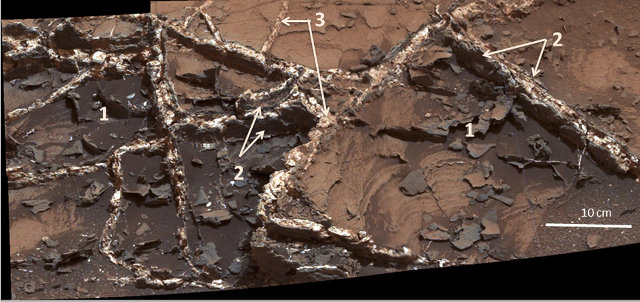
At the 47th annual meeting of the American Astronomical Society’s Division for Planetary Sciences in National Harbor, Maryland, scientists of NASA’s Mars Rover Curiosity mission presented the results of new analyzes of the Martian site called Garden City. It’s an area visited in March 2015 that turned out to be very interesting from the geological point of view because of its chemical diversity and for its mineral veins, which protrude from the rocks they formed on.
The biggest update made so far to the software that runs Curiosity’s Chemistry and Camera (ChemCam) instrument considerably enhanceed it. In fact, it allowed an improvement in the interpretation of the collected data making it more sensitive to a wider range of possible compositions of the Martian rocks.
The diversity in the veins composition indicates that there were several episodes of water passing through rock fractures. In different periods in which the water flowed, different substances dissolved in it were transported. When conditions became drier, the fluids left behind clues that scientists are now analyzing to understand the changes that occurred over time.
ChemCam was used to collect data using its laser on 17 targets at Garden City. Among the substances found there are calcium sulphate in certain veins and magnesium sulfate in others. Further veins turned out to be rich in fluorine or containing varying amounts of iron.
Updating ChemCam’s analysis software allowed to recalibrate the instrument that greatly helped to understand the chemistry of Garden City. Diana Blaney, a Curiosity team scientist, stated that it would have been very enigmatic prior to this recalibration. It’s one of the cases where the experience gained in the use of an instrument can lead to improve its management to exploit it in a better way.
The variety in Garden City’s mineral veins is also visible to the naked eye in the photographs taken by the Mars Rover Curiosity’s Mast Camera (MastCam). In the image of the veins details it’s possible to note the variations in thickness and brightness. The different types of material include: thin, dark-toned fracture filling material (1), thick, dark-toned vein material in large fractures (2) and light-toned vein material, which was deposited last (3).
The chemistry of the veins examined is related to mineral variations found in other sites in the vicinity of Mount Sharp, where the Mars Rover Curiosity rose even more after leaving Garden City. For this reason, the data collected can be used to understand the chemical history of a broader area, another bit of the history of the planet Mars.
[ad name=”eBayUSUKNASA”]
