
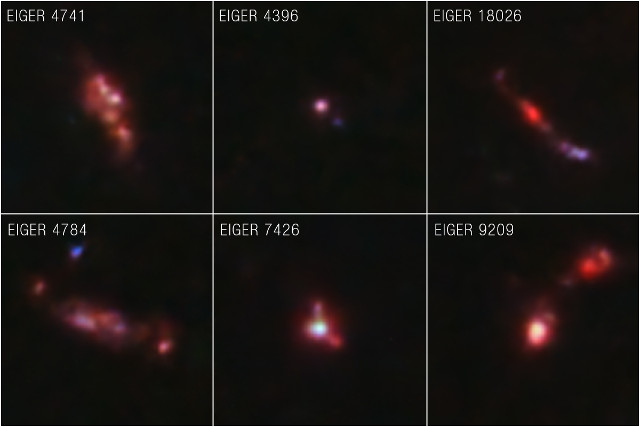
Three articles – available here, here, and here – published in “The Astrophysical Journal” report various aspects of a study on the epoch of reionization and bring evidence that the first galaxies transformed the universe from an opaque place to the current place where light can spread. Researchers from the EIGER team led by Simon Lilly of the ETH Zurich, Switzerland, used the James Webb Space Telescope together with some ground-based telescopes to observe primordial galaxies finding transparent regions around them thanks to the reionization of the gas.
The epoch of reionization was a pivotal period in the history of the universe in which hydrogen, which was neutral in the early life of the universe, was separated into protons and electrons. Neutral hydrogen blocked light, so reionization transformed the universe from a dark place to one illuminated by the light of primordial stars. Astronomers are trying to pinpoint the causes of that process.
The EIGER (Emission-line galaxies and Intergalactic Gas in the Epoch of Reionization) project has the precise aim of studying intergalactic gas and galaxies in the epoch of reionization. Astronomers have long been trying to reconstruct that crucial event for the universe and their suspicions fell on the activity of primordial galaxies.
Simon Lilly’s team exploited the quasar J0100+2802, an active galactic nucleus powered by a supermassive black hole surrounded by materials heated to the point of generating very powerful electromagnetic emissions. The problem is being able to examine the area around primordial quasars and the EIGER team combined observations from different telescopes to exploit the quasar’s luminosity to study galaxies in that area of space.
The picture (NASA, ESA, CSA, Simon Lilly (ETH Zurich), Daichi Kashino (Nagoya University), Jorryt Matthee (ETH Zurich), Christina Eilers (MIT), Rongmon Bordoloi (NCSU), Ruari Mackenzie (ETH Zurich). Processing: Alyssa Pagan (STScI), Ruari Mackenzie (ETH Zurich)) shows galaxies observed in this study, which we see as they were when the universe was 900 million years old.
The James Webb Space Telescope was designed to study the early universe, and the NIRCam (Near-Infrared Camera) instrument provided considerable assistance in this study. The spectrographic data were combined with observations of the area around the quasar J0100+2802 conducted with the Keck, VLT, and Magellan telescopes to obtain valuable information on the composition and state of the intergalactic gas in that area.
The result was the discovery that the primordial galaxies illuminated by the quasar J0100+2802 are generally surrounded by transparent regions with a radius of around two million light-years. In essence, the astronomers saw those galaxies making their surrounding space transparent by ionizing intergalactic gas at the end of the reionization era.
The young galaxies observed in this study are still in their formation stage, with still irregular shapes. In that chaotic situation, there is considerable star formation and many supernovae are expected due to the large mass of those stars. This is important because it could confirm that those events generated the energy that ionized the intergalactic gas causing the reionization of the universe.
The researchers plan to continue this type of study by looking for galaxies in five other areas where they surround a quasar. The James Webb Space Telescope provided better than expected results with the galaxies around the quasar J0100+2802, so there are good hopes of obtaining new confirmations that young galaxies made the universe transparent and therefore bright.
