Massimo Luciani

Arcadia Planitia on Mars

ESA has published a photo of the Arcadia Planitia region on Mars captured by its Mars Express space probe’s High Resolution Stereo Camera (HRSC). This is an interesting region from a geological point of view because it’s northwest of the large volcanoes of Tharsis, the largest in the entire solar system, and traces of ancient lava flows are still visible. It could be important for the exploration of the red planet if confirmation of the presence of frozen water right under the surface were to arrive.

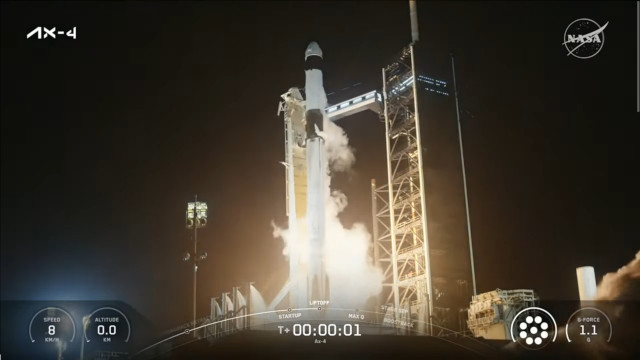
The Crew Dragon Grace spacecraft blasting off atop a Falcon 9 rocket to start its Ax-4 mission (Image NASA)

A little while ago, SpaceX’s Crew Dragon Grace spacecraft was launched atop a Falcon 9 rocket from the Kennedy Space Center on the Axiom Mission 4, or simply Ax-4, mission. After about twelve minutes, it successfully separated from the rocket’s last stage. It will spend up to 14 days in orbit, almost all of which will be docked at the International Space Station. It also serves commercial purposes in a collaboration between SpaceX, Axiom Space, and various companies and national space agencies to access the Station for the purpose of conducting tasks useful for the development of new technologies and for scientific research.

SpaceX's Starship 36 prototype exploding (Image courtesy Jerry Pike / NASASpaceflight)

A few hours ago, SpaceX was setting up the Starship 36 prototype for a static fire test, the ignition of the six Raptor engines on the ground in preparation for what was supposed to be the 10th launch test to be conducted together with the Super Heavy rocket. It was just after 11 pm in Texas when Starship 36 exploded. Even the static fire tests are conducted in safe conditions, so the SpaceX staff was well away from the prototype, and no one was injured. It must be said that mishaps can happen more easily with prototypes, but it’s clear that, at best, there will be further delays on the development schedule of a spacecraft that has already suffered three failures in the latest flight tests.

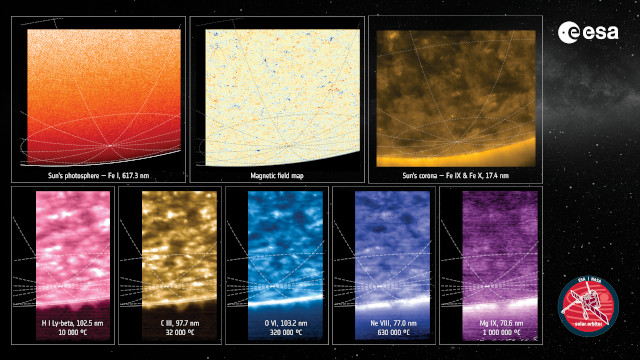
The Sun observed across eight different wavelengths by the Solar Orbiter space probe

ESA has released the first information, including the first images, of the Sun’s South Pole, captured between March 16 and 17, 2025, by the Solar Orbiter space probe, a mission operated in collaboration with NASA. Three of the scientific instruments on board made it possible to observe that area in different electromagnetic bands: Polarimetric and Helioseismic Imager (PHI), Extreme Ultraviolet Imager (EUI), and Spectral Imaging of the Coronal Environment (SPICE). The Sun’s poles aren’t visible from Earth, and Solar Orbiter is observing them as never before. The first observations have already revealed some surprises.

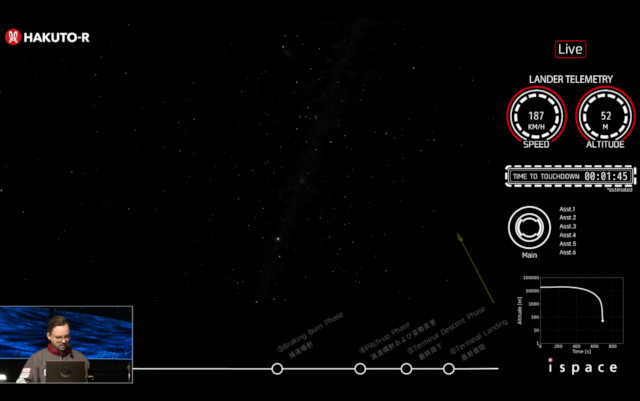
A simulation of the Hakuto-R Resilience lander's trajectory

It was early morning in Tokyo when the Hakuto-R Resilience lander of the Japanese company ispace inc. attempted the Moon landing. For the people who watched the conclusion of the first Hakuto-R lander’s mission, the end of Resilience’s mission unfortunately offered a sense of deja vu. This time, the telemetry transmission was interrupted less than two minutes before the Moon landing, when the speed was measured at 187 km/h at an altitude of 52 meters. This was the so-called Phase 4, during which Resilience was supposed to decelerate. The clear impression is that something went wrong, and this second mission also ended in a crash.