Massimo Luciani

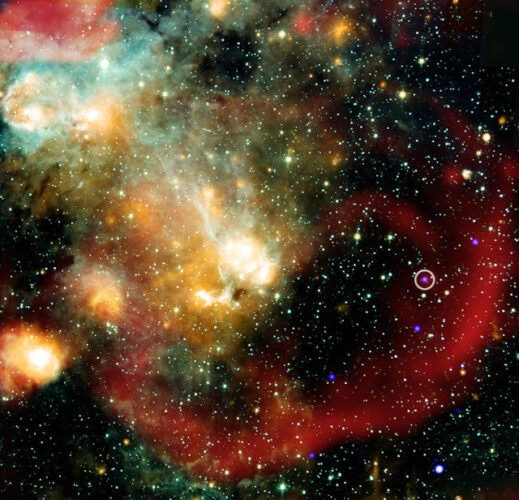
ASKAP J1832-0911 (in the circle) (Image X-ray: NASA/CXC/ICRAR, Curtin Univ., Z. Wang et al.; Infrared: NASA/JPL/CalTech/IPAC; Radio: SARAO/MeerKAT; Image processing: NASA/CXC/SAO/N. Wolk)

An article published in the journal “Nature” reports a study on ASKAP J1832-0911, or simply ASKAP J1832, an object whose nature is still uncertain. A team of researchers combined data collected by different instruments, including NASA’s Chandra X-ray Observatory and the ASKAP radio telescope, to detect the emissions coming from this object. This allowed them to reveal anomalies with respect to the categories considered to try to identify it.

The radio emissions led to cataloging it as a long-period radio transient, but ASKAP J1832 has variable emissions of the same duration in X-rays as well. An object with that type of emissions has never been found before, so it arouses a lot of curiosity. It could be a magnetar or a white dwarf with a companion star, but its behavior remains strange, so the investigations will continue.

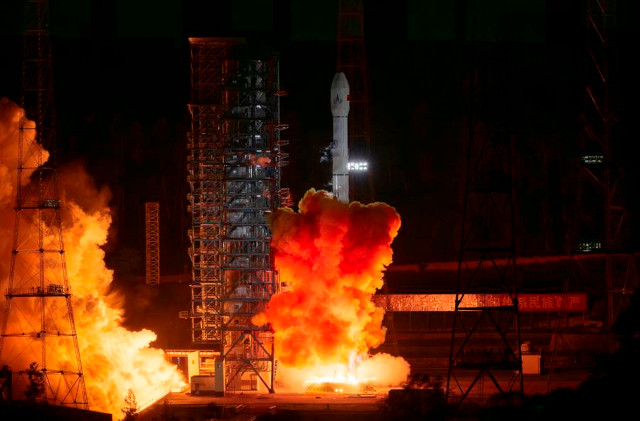
The Tianwen-2 space probe blasting off atop a Long March 3B rocket (Photo courtesy Xinhua/Cai Yang)

A few hours ago, the Tianwen-2 mission was successfully launched. A Long March 3B rocket blasted off from the Xichang Satellite Launch Center, and after about 18 minutes, the space probe separated from the rocket’s last stage to begin its journey towards the asteroid 469219 Kamoʻoalewa. The goal is to collect samples from its surface to bring back to Earth and then resume its journey in space towards the comet 311P/PanSTARRS.

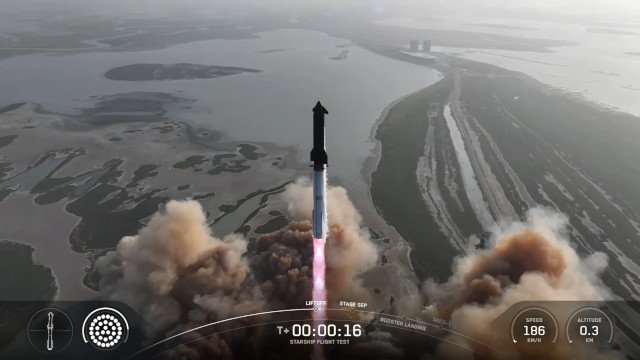
Super Heavy Booster 14 and Starship 35 blasting off (Image courtesy SpaceX)

It was the afternoon in the USA when SpaceX conducted a new flight test of its Super Heavy rocket and Starship prototypes, launched from its base in Boca Chica, Texas. This is the 9th test involving the entire system of Elon Musk’s company, which is supposed to revolutionize space travel with an unprecedented transport capacity and being totally reusable. They are advanced prototypes with the Super Heavy identified as Booster 14, on its second flight in the first reuse of a Super Heavy, and the Starship Block 2 identified as Starship 35 or Ship35 or simply S35.

A few hours ago, SpaceX’s Dragon spacecraft ended its CRS-32 (Cargo Resupply Service 32) mission for NASA splashing down smoothly off the coast of California. The Dragon left the International Space Station about 36 hours earlier. For SpaceX, this was the 12th mission of the 2nd contract with NASA to transport supplies to the Station with the new version of the Dragon cargo spacecraft. The Dragon spacecraft had reached the International Space Station on April 22.

The Magellanic Clouds as seen by the Gaia space probe (Image ESA)

An article published in “The Astrophysical Journal Letters” reports the results of a study of the Small Magellanic Cloud that shows how this dwarf galaxy is undergoing distortions in its shape due to various gravitational influences. Satoya Nakano and Kengo Tachihara of Nagoya University, Japan, used data collected by ESA’s Gaia space probe together with information on Cepheid stars collected by the OGLE (Optical Gravitational Lensing Experiment) project. This allowed them to determine the distances of 4,236 Cepheids and the anomalies in their motions. The conclusion is that the Small Magellanic Cloud is undergoing a gravitational influence from the Large Magellanic Cloud and another as yet unknown source.