Massimo Luciani

On the left the supernova SN 1987A remnant as seen by the James Webb Space Telescope, and in the other two panels the simulation of the density distribution of the remnant, which include the iron-rich materials, and the current morphology of that remnant

An article to be published in the journal “Astronomy & Astrophysics” reports a study of the supernova SN 1987A that offers evidence that the explosion was decidedly asymmetric and dominated by two bipolar jets. A team of researchers led by astrophysicist Salvatore Orlando of the Italian National Institute of Astrophysics in Palermo has developed a model that takes into account the interaction between matter and magnetic field to study the evolution of SN 1987A. The results successfully reproduce the morphology of the iron-rich ejected materials, which was observed in particular by the James Webb Space Telescope. This shows that those structures are the result of an asymmetric explosion.

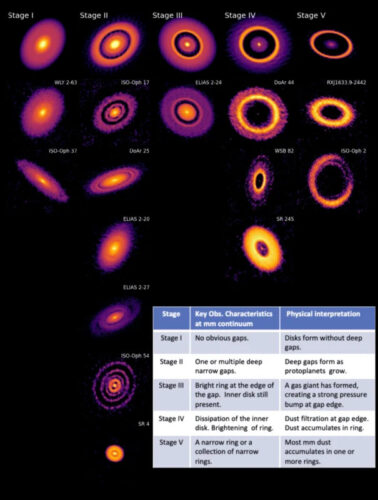
15 protoplanetary disks studied in the ODISEA project with their classification according to the proposed model

An article published in “The Astrophysical Journal Letters” reports a model that traces the evolution of protoplanetary disks through five stages. A team of researchers from the ODISEA (Ophiuchus DIsc Survey Employing ALMA) project developed this model using both simulations and observations of protoplanetary disks within the Ophiuchus molecular cloud obtained using the ALMA radio telescope. The type of evolution observed confirms the division into stages proposed in 2020 in an article published in the journal “Monthly Notices of the Royal Astronomical Society” and offers some confirmation of the mechanisms by which giant planets influence the dynamics within those disks.

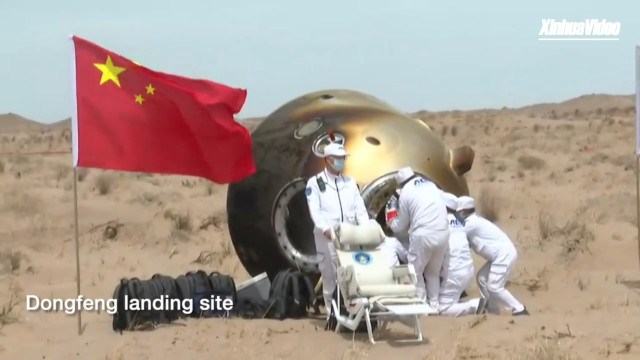
The Shenzhou 19 capsule after landing (Image courtesy Xinhua)

A few hours ago, the three Chinese taikonauts of the Shenzhou 19 mission returned to Earth after spending a little more than six months on the Chinese space station Tiangong, where they arrived on October 29, 2024. The three taikonauts Wang Haoze, Cai Xuzhe, and Song Lingdong had left the station about nine hours earlier to land at a site called Dongfeng in China’s Inner Mongolia Autonomous Region. It’s a procedure that significantly reduces the time to return to Earth and now has become routine.

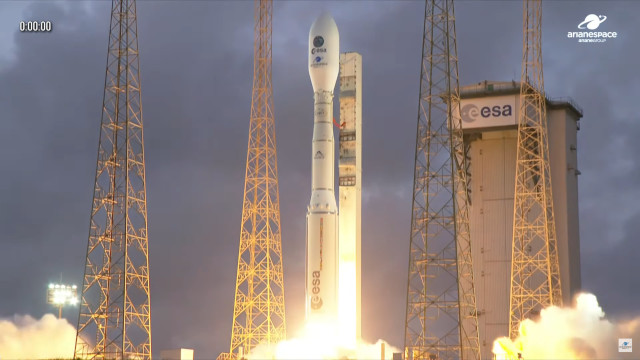
The Biomass satellite blasting off atop a Vega-C rocket (Image courtesy Arianespace)

A little while ago, the Biomass satellite was launched atop a Vega-C rocket from the Kourou base in French Guiana. After about 58 minutes, it successfully separated from the rocket’s last stage and set off on a course that will take it to its Sun-synchronous orbit at an altitude of 666 kilometres, where it will study the biomass of forests around the world. This work will help us better understand the global carbon cycle and forest ecosystems.

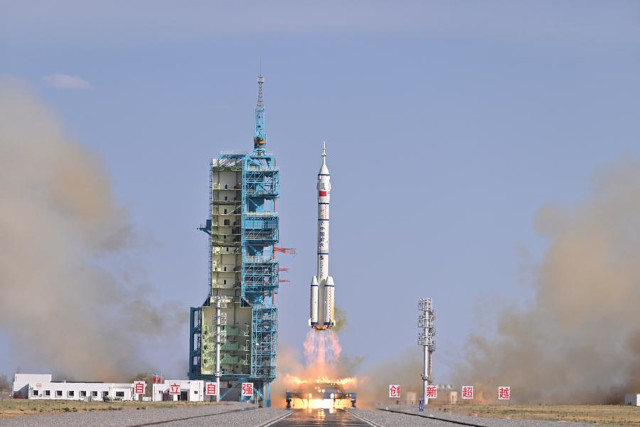
The Shenzhou 20 spacecraft blasting off (Photo courtesy Xinhua/Li Xin)

A confirmation has arrived that three Chinese taikonauts from the Shenzhou 20 mission reached the Chinese space station Tiangong with an automated docking maneuver. They blasted off about 6.5 hours earlier atop a Long March-2F rocket from the Jiuquan Satellite Launch Center. They form the 9th crew of the Chinese space station and will remain there for about six months, the standard duration for a mission.