Massimo Luciani

Herbig-Haro 49/50 (NIRCam and MIRI Image, annotated)

An image captured by the James Webb Space Telescope shows Herbig-Haro 49/50, or simply HH 49/50, a type of nebula associated with star formation. The Near-Infrared Camera (NIRCam) and Mid-Infrared Instrument (MIRI) instruments were used in combination to observe infrared details of the outflows whose shape led to the object being nicknamed the Cosmic Tornado. For years, astronomers have wondered what the object they could barely see in images obtained with other instruments at the “tip of the tornado” was, and Webb helped them realize that it’s a spiral galaxy that is far more distant.

The Crew Dragon Freedom spacecraft right after splashdown (Image courtesy SpaceX)

A few hours ago, SpaceX’s Crew Dragon Freedom spacecraft concluded its Crew-9, or SpaceX Crew-9, mission for NASA by landing without problems. On board were astronauts Nick Hague and cosmonaut Alexander Gorbunov, who reached the International Space Station on September 29, 2024, and were part of Expedition 72, along with astronauts Suni Williams and Butch Wilmore, who reached the International Space Station on Boeing’s Starliner Calypso spacecraft on June 6, 2024, and were part of Expedition 71/72. The original members of the Crew-9 mission completed SpaceX’s 9th regular crewed mission of in the Atlantic Ocean, off the coast of Florida. The Crew Dragon departed the Station almost 17 hours earlier.

The Crew Dragon Endurance spacecraft docking with the Harmony module as seen from inside the International Space Station

A few hours ago, SpaceX’s Crew Dragon Endurance spacecraft docked with the Harmony module of the International Space Station completing the first part of its Crew-10 or SpaceX Crew-10 mission that began with its launch about 28.5 hours earlier. After checking that the pressure gets properly balanced, the hatch will be opened to allow Anne McClain, Nichole Ayers, Takuya Onishi, and Kirill Peskov to enter the Station and start their mission, which will last about five months.

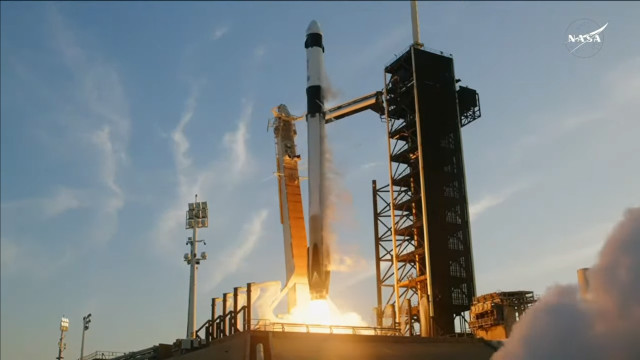
The Crew Dragon Endurance spacecraft blasting off atop a Falcon 9 rocket to start the Crew-10 mission (Image NASA)

A few hours ago, SpaceX’s Crew Dragon Endurance spacecraft blasted off atop a Falcon 9 rocket from the Kennedy Space Center in its Crew-10 or SpaceX Crew-10 mission. After almost exactly ten minutes, it successfully separated from the rocket’s last stage and went en route to carry out its mission. This is the 10th crewed mission of the Crew Dragon spacecraft within the normal rotation of the International Space Station crew.

Artist’s Illustration of Exoplanets Orbiting Barnard’s Star (Image International Gemini Observatory/NOIRLab/NSF/AURA/P. Marenfeld)

An article published in “The Astrophysical Journal Letters” reports confirmation of the existence of four exoplanets that are smaller than Earth orbiting Barnard’s Star. A team of researchers combined detections obtained with the MAROON-X instrument mounted on the Gemini North telescope in Hawaii with others obtained independently with the ESPRESSO instrument installed on ESO’s VLT in Chile. The result is the confirmation of the exoplanet Barnard b, whose existence was announced in October 2024, and three other sub-Earths, small planets that are almost certainly rocky.