Massimo Luciani

The SPHEREx space telescope and the PUNCH satellites blasting off atop a Falcon 9 rocket (Image courtesy SpaceX)

A few hours ago, the SPHEREx space telescope and the PUNCH satellites, two NASA astronomy missions, blasted off atop a SpaceX Falcon 9 rocket from the Vandenberg base. After about 42 minutes, SPHEREx successfully separated from the rocket’s last stage, and about 10 minutes later, the PUNCH satellites also separated, within about a minute. Both missions will operate from a Sun-synchronous orbit at an altitude of 700 kilometers for SPHEREx and 570 kilometers for PUNCH.

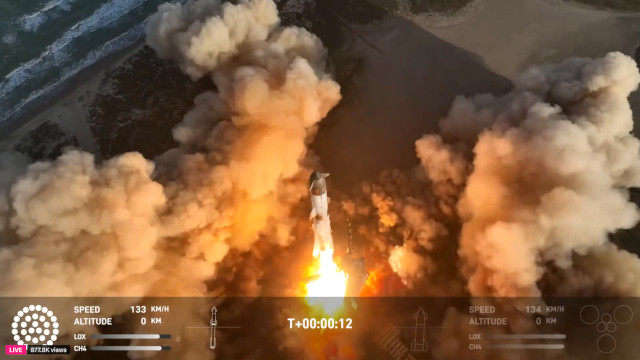
Super Heavy 15 and Starship 34 at liftoff (Image courtesy SpaceX)

It was the afternoon in the USA when SpaceX conducted a new flight test of its Super Heavy rocket and Starship prototypes, launched from its base in Boca Chica, Texas. This is the 8th test involving the entire system of Elon Musk’s company which is supposed to revolutionize space travel with an unprecedented transport capacity and being totally reusable. They are advanced prototypes with the Super Heavy identified as Booster 15 and the Starship Block 2 identified as Starship 34 or Ship34 or simply S34.

Image captured by Machines’ Nova-C Athena lander during its descent (Image courtesy Intuitive Machines / NASA)

A little while ago, Intuitive Machines’ Nova-C Athena lander attempted its Moon landing in the Mons Mouton area. This was an autonomous maneuver that was the key step in the IM-2 mission. In the minutes following the end of the maneuver, signals started arriving at mission control with increasing clarity. This allowed them to start understanding Athena’s situation.

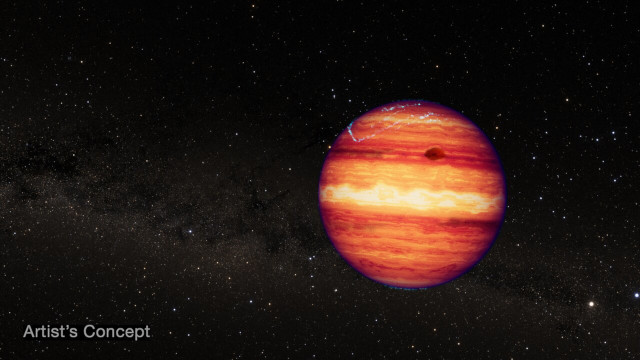
Artist’s concept of SIMP 0136 (Image NASA, ESA, CSA, J. Olmsted (STScI))

An article published in “The Astrophysical Journal Letters” reports the results of a study of the super-Jupiter object cataloged as SIMP J013656.5+093347.3 and referred to as SIMP J0136+09 or simply SIMP 0136. A team of researchers used observations conducted with the James Webb Space Telescope to monitor the infrared emissions from this object. Its nature is still undetermined because it has an estimated mass of around 13 times Jupiter’s, at the boundary between a planet and a brown dwarf. The result is the discovery of an atmosphere that varies quickly, probably due to layers of clouds with different chemical compositions.

Graphic representation of the Blue Ghost M1 lander on the Moon (Image courtesy NASA / Firefly Aerospace)

A little while ago, Firefly Aerospace’s Blue Ghost lander attempted a Moon landing in Mare Crisium. This was an autonomous maneuver that was the key step in what is known as Mission 1. After completing its braking and touching down on the Moon’s surface, Blue Ghost sent signals from its sensors confirming its success. After just over half an hour, it started sending images of the Moon’s surface.