Massimo Luciani

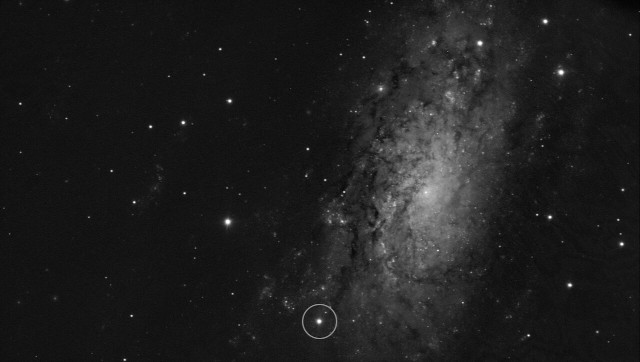
Galaxy NGC 3621 with the location of supernova SN 2024ggi in the small circle

An article published in the journal “Science Advances” reports the first reconstruction ever of the shape of a Type II supernova in its early stages. A team of researchers led by Professor Yi Yang of Tsinghua University in Beijing, China, used observations conducted with ESO’s Very Large Telescope (VLT) in Chile to study the supernova cataloged as SN 2024ggi on April 11, 2024, the day after the explosion began.

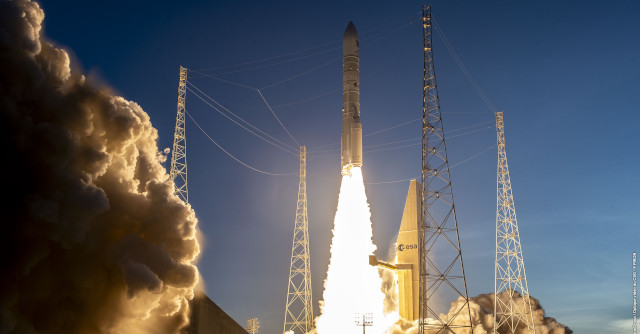
The Sentinel-1D satellite blasting off atop an Ariane 6 rocket (Photo courtesy ESA-CNES-ARIANESPACE/Optique vidéo du CSG–P. Piron. ESA Standard Licence)

A few hours ago, the Sentinel-1D satellite, part of the Copernicus / GMES, was launched from the Kourou spaceport, in French Guiana, atop an Ariane 6 rocket. After about 34 minutes, the satellite regularly separated from the rocket’s last stage and started sending signals. Its final orbit in low Earth orbit will be at an altitude of about 693 kilometers.

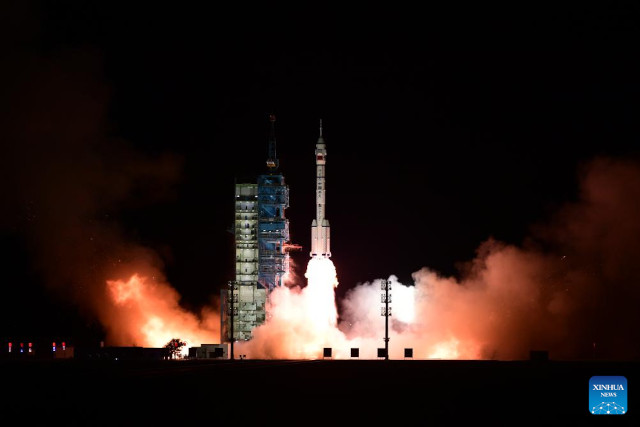
The Shenzhou 21 spacecraft blasting off atop a Long March-2F rocket (Photo courtesy Xinhua)

A confirmation has arrived that three Chinese taikonauts from the Shenzhou 21 mission reached the Chinese space station Tiangong with an automated docking maneuver. They blasted off about 3.5 hours earlier atop a Long March-2F rocket from the Jiuquan Satellite Launch Center. They form the 10th crew of the Chinese space station and will remain there for about six months, the standard duration for a mission.

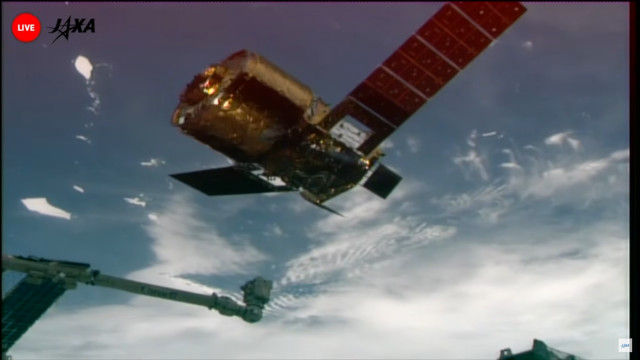
The HTV-X1 cargo spacecraft approaching the International Space Station (Image courtesy JAXA)

A little while ago, the HTV-X1 spacecraft was captured by the International Space Station’s Canadarm2 robotic arm, operated by astronaut Kimiya Yui. The Japanese space cargo ship, which blasted off when it was Sunday in Japan, carries a huge amount of supplies and experiments. After its capture, they started the slow moving of the HTV-X1 to its berthing location on the Harmony module, where it will be safely installed.

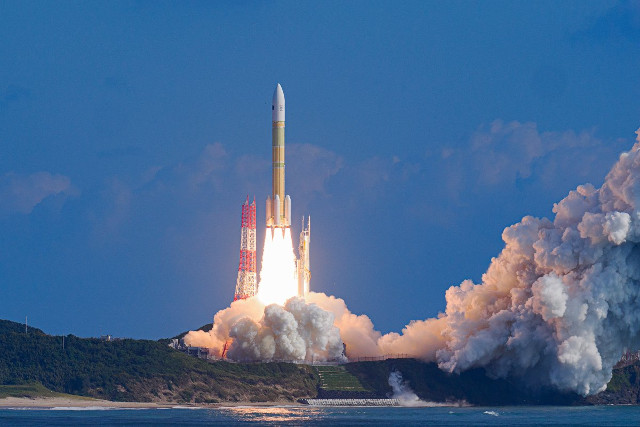
The HTV-X1 cargo spacecraft blasting off atop a H3-24W rocket (Photo courtesy JAXA)

A few hours ago, the HTV-X1 spacecraft blasted off atop a H3-24W rocket from the Tanegashima space center in Japan for a resupply mission to the International Space Station. A little more than 14 minutes after the launch, the cargo spacecraft separated regularly from the rocket’s last stage, entered its preliminary orbit, and deployed its solar panels and navigation antennas. It’s the new Japanese cargo spacecraft HTV-X’s maiden launch.